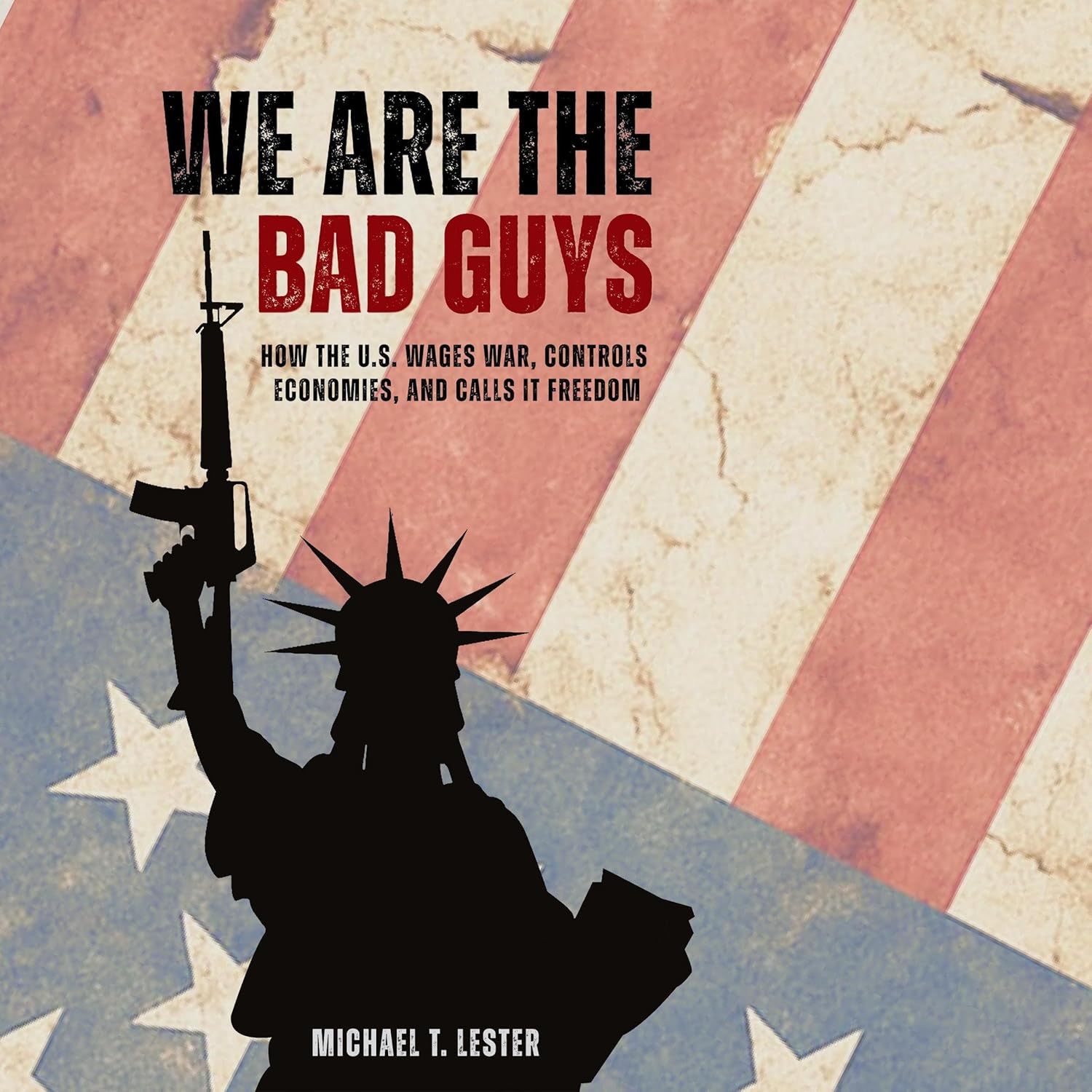
We Are the Bad Guys: The Global Cost of American Power by Michael T. Lester is a provocative, insider-driven work of political nonfiction published on November 3, 2025. The author, a former U.S. Marine Corps combat pilot and Naval Academy graduate who served across Asia and the Middle East, offers a critical examination of American foreign policy, military interventions, economic influence, and global power dynamics.
Overview
Lester begins from a place of personal disillusionment. He once fully believed the narrative of American exceptionalism — that the United States acts as a force for freedom, democracy, and stability in the world. Over two decades of service and subsequent research, he came to see a consistent gap between official rhetoric and on-the-ground realities. The book argues that many of America’s actions — from overt wars and covert operations to economic sanctions, intelligence activities, and cultural influence — have functioned as tools of empire-building rather than pure benevolence.
The central thesis is straightforward yet uncomfortable for many readers: from the perspective of much of the world, the United States often behaves as “the bad guys,” prioritizing control, resource access, and strategic dominance over the ideals it publicly champions. Lester does not frame this as anti-American hatred but as a call for honest self-examination. He suggests that ignoring these patterns harms both other nations and American democracy itself in the long run.
Main Content and Structure
The book pulls together elements that are often discussed separately and shows how they form a coherent pattern of power projection:
- Military interventions and regime change — Detailed looks at U.S. involvement in Latin America, the Middle East, Southeast Asia, and elsewhere, including coups, invasions, and support for proxy forces.
- Economic and financial tools — Sanctions, trade policies, and debt mechanisms that can destabilize or control other countries without firing a shot.
- Intelligence and covert operations — The role of the CIA and other agencies in shaping governments and narratives abroad.
- Media and propaganda — How language like “freedom,” “democracy,” and “national security” is used to build domestic support and justify actions.
- Human and environmental costs — The impact on local populations, including civilian casualties, displacement, economic ruin, and long-term instability.
Lester draws on declassified documents, leaked cables, government records, and respected historical scholarship to support his points. He also weaves in observations from his own service, where official briefings frequently clashed with what he witnessed.
Tone and Style
The writing is clear, accessible, and straightforward rather than academic or overly theoretical. Lester writes with the disciplined voice of a military officer — factual, evidence-based, and restrained. He avoids sensationalism or conspiracy-mongering, focusing instead on documented patterns and their consequences. The tone is sober and critical but not bitter; the author repeatedly emphasizes that confronting uncomfortable truths can make the country stronger, not weaker.
Who It’s For
- Readers interested in U.S. foreign policy, geopolitics, and international relations
- People who want an insider’s perspective from someone who served in the system and later questioned it
- Those open to challenging mainstream narratives about American power and exceptionalism
- Anyone seeking a big-picture analysis of how U.S. actions are perceived globally
Final Thoughts
We Are the Bad Guys is a bold, thought-provoking book that asks Americans to look at their country’s role in the world through the eyes of those on the receiving end of its power. It connects wars, sanctions, covert actions, and media framing into a larger story of empire and control. Whether you agree with all of Lester’s conclusions or not, the book raises serious questions that are rarely discussed openly in mainstream discourse.
It is a sobering read that encourages reflection on the real costs — human, economic, and moral — of maintaining global dominance, and what that means for America’s future at home and abroad.
If you enjoy critical histories of U.S. foreign policy or books that challenge conventional wisdom with documented evidence, this one is worth your time.