
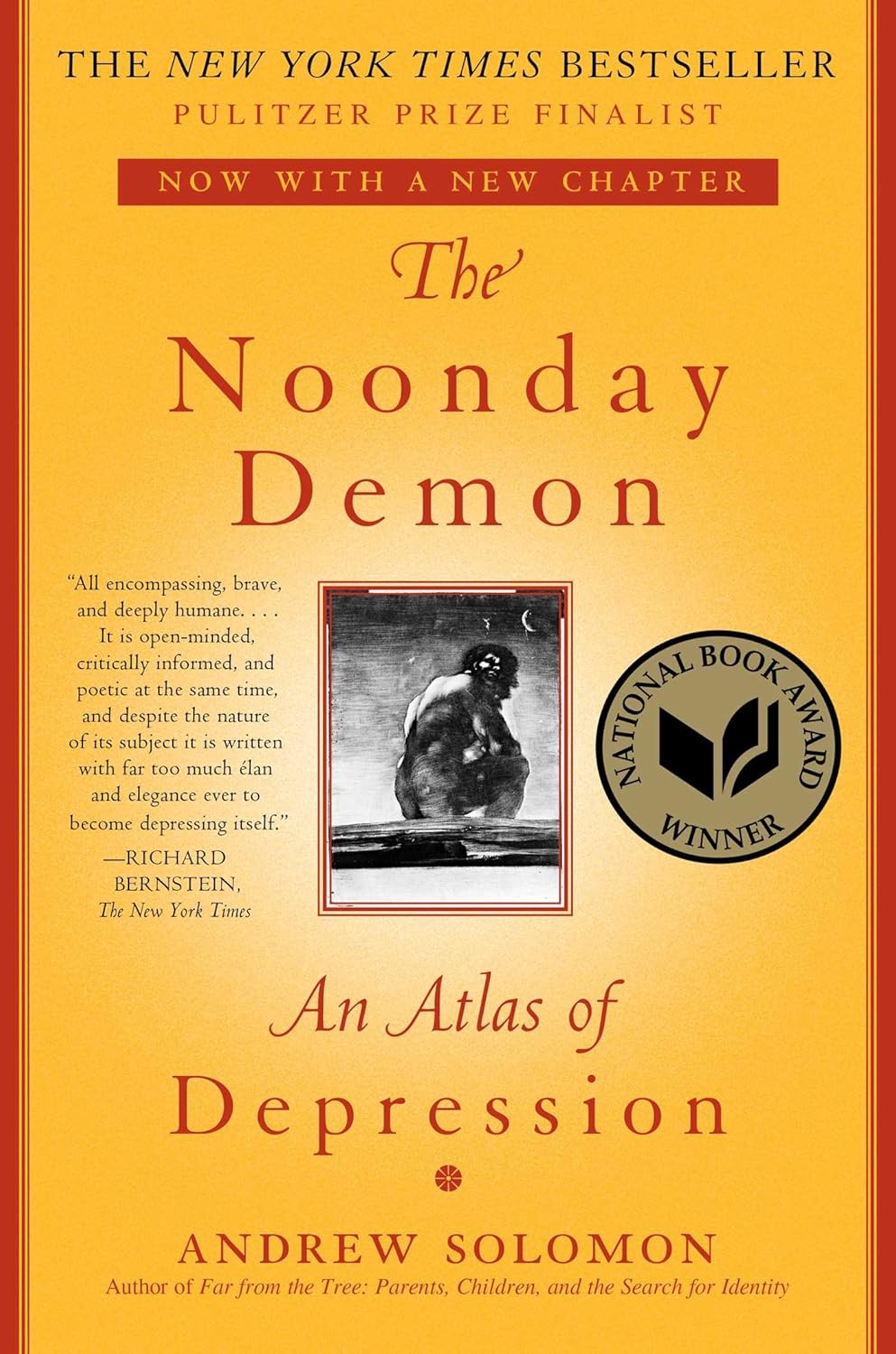
The Noonday Demon: An Atlas of Depression by Andrew Solomon is a landmark work of nonfiction. It was first published in 2000 and won the National Book Award for Nonfiction. The book remains one of the most comprehensive and compassionate explorations of depression ever written. It combines personal memoir, rigorous reporting, scientific insight, political analysis, and philosophical reflection.
Overview and Structure
The title comes from Psalm 91:6 in the King James Bible, referring to the “destruction that wasteth at noonday”—an ancient name for the demon of acedia or midday melancholy. Solomon uses this image to frame depression as both a timeless human experience and a modern epidemic.
The book is organized like an atlas: a series of detailed maps of different territories of depression. Each chapter examines a different angle or population affected by the illness. Solomon travels the world and interviews hundreds of people—patients, families, doctors, researchers, and historical figures—to build a panoramic view.
Key sections include:
- Personal stories of severe, treatment-resistant depression
- Depression in children and adolescents
- Depression among the poor and politically oppressed
- Cultural differences in how depression is experienced and named
- The biochemistry and genetics of the illness
- The history of treatments from ancient times to modern psychopharmacology and talk therapy
- Suicide, its prevention, and its aftermath
- Addiction and depression’s frequent companion
- Positive outcomes, recovery, and the possibility of growth through suffering
Content and Approach
Solomon does not present depression as a single, tidy disease with one cause and one cure. He shows it as a complex condition shaped by biology, psychology, society, history, and individual temperament. He refuses easy answers. He gives equal weight to medication, psychotherapy, alternative treatments, lifestyle changes, spirituality, and social justice.
The book is deeply empathetic. Solomon himself has lived with severe depression since childhood. He writes from inside the experience while maintaining journalistic distance. His prose is elegant, precise, and often poetic. He avoids clinical coldness and self-pity alike.
Some of the most powerful chapters explore:
- The story of Lolly, a woman whose depression began in early childhood and never fully lifted
- Depression in rural Africa, where the illness is often understood through spiritual rather than medical lenses
- The use of ECT (electroconvulsive therapy) and its controversial but sometimes life-saving role
- The experience of artists and writers who have turned depression into creative fuel
Key Themes
- Depression is real, biological, and often devastating, yet it is also shaped by culture and circumstance.
- No single treatment works for everyone; recovery is highly individual.
- Stigma remains a major barrier to care and understanding.
- Depression can coexist with meaning, beauty, and even wisdom.
- Society’s failure to address poverty, trauma, inequality, and isolation worsens the global burden of depression.
Impact and Reception
The Noonday Demon is widely regarded as essential reading for anyone touched by depression—patients, families, clinicians, policymakers. It humanizes the illness without romanticizing it. Critics praise its depth, honesty, and refusal to simplify. Some readers find its length and detail overwhelming, but most consider that part of its strength.
The book has not dated significantly. While science has advanced (especially in genetics, neuroimaging, and new treatments like ketamine and psychedelics), Solomon’s core insights about the lived experience of depression remain fresh and urgent.
In short, this is a profound, exhaustive, and humane map of one of humanity’s oldest afflictions. It offers no quick fixes, but it offers deep companionship to anyone walking through darkness. It remains a classic of medical humanities and a vital resource for understanding the noonday demon in all its forms.