
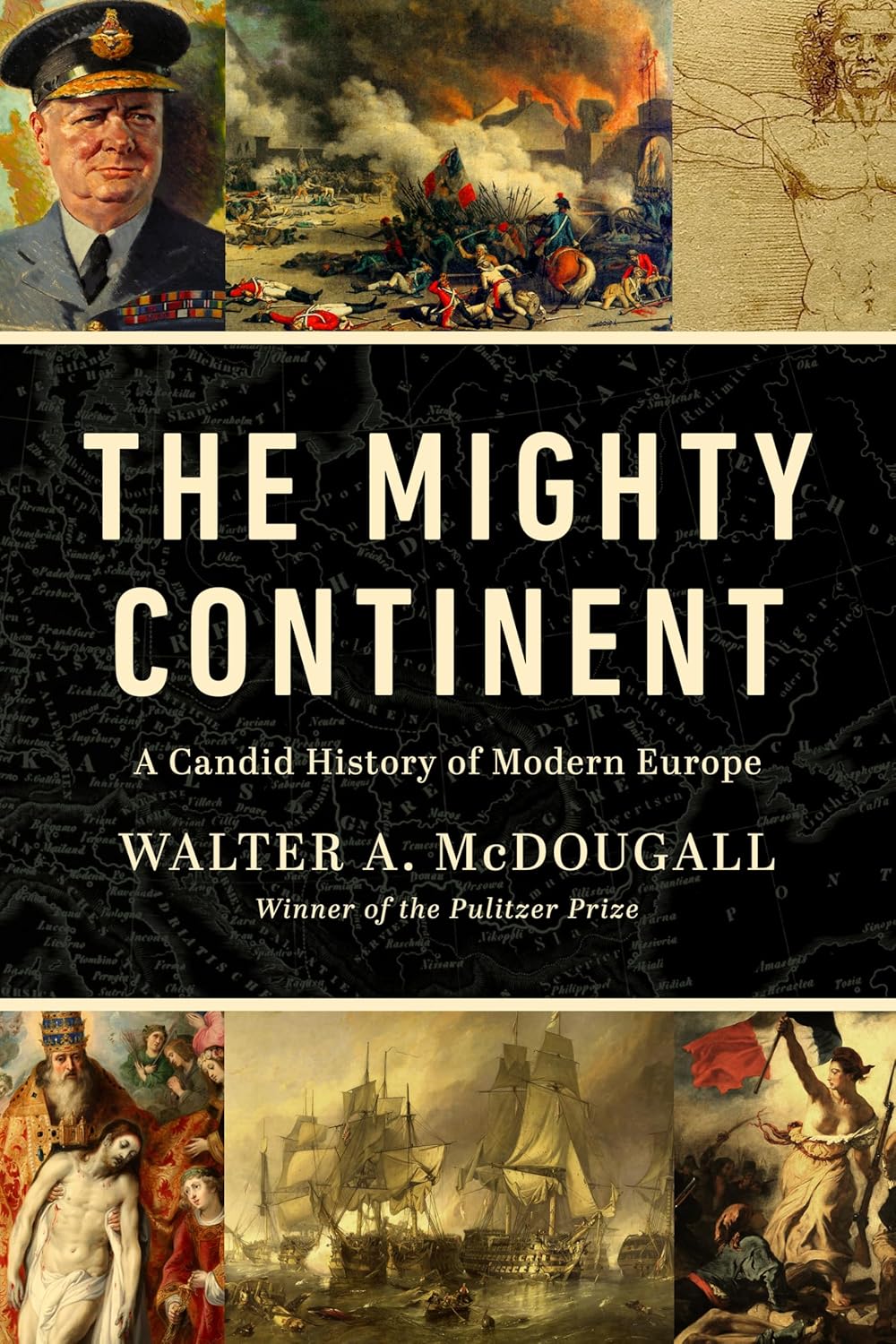
The Mighty Continent: A Candid History of Modern Europe by Derek Fraser is a brisk, unsparing single-volume history of Europe from roughly 1815 to the present day. Published in early 2026 by Profile Books (UK) / Basic Books (US), the book aims to cut through romantic myths, national exceptionalism, and selective memory to present a clear-eyed account of how the continent that once dominated the globe became a prosperous but diminished power in the twenty-first century.
Plot Overview
Fraser divides the story into four large arcs:
- The Long Nineteenth Century (1815–1914)
The Congress of Vienna creates a stable but conservative order. Industrialisation, nationalism, and liberalism drive massive change. Fraser highlights how Britain’s naval and economic supremacy, the unification of Germany and Italy, the decline of the Ottoman and Habsburg empires, and the scramble for Africa set the stage for catastrophe. He stresses that the pre-1914 world was not a golden age of progress; it was an era of sharpening rivalries and unresolved tensions. - The Thirty Years’ Crisis (1914–1945)
World War I shatters the old empires and unleashes revolution, fascism, and economic collapse. Fraser devotes substantial space to the ideological battle between liberal democracy, communism, and fascism. He treats the interwar years as a single extended crisis rather than separate wars. The Holocaust, the Nazi-Soviet pact, the appeasement years, and the total war of 1939–1945 are presented not as aberrations but as logical outcomes of earlier choices. Stalin’s purges and forced collectivisation receive equal scrutiny with Hitler’s crimes. - The Cold War and the Rebirth of Western Europe (1945–1989)
The division of the continent into rival blocs is the central fact of the postwar era. Fraser covers the Marshall Plan, NATO, the European Coal and Steel Community (precursor to the EU), decolonisation, the economic miracles in West Germany, France, and Italy, and the contrasting stagnation and repression in the Soviet bloc. He gives credit to the stability provided by American power while noting the moral compromises (support for dictators in southern Europe, tolerance of Franco and Salazar). The 1968 protests, détente, the Helsinki Accords, and the Polish Solidarity movement are framed as cracks that eventually brought down the Iron Curtain. - Post-1989 Europe: Unity, Crisis, and Uncertainty (1989–present)
The fall of the Berlin Wall and the collapse of the Soviet Union appear to mark the triumph of liberal democracy and the “end of history.” Yet Fraser shows how quickly new fractures appeared: Yugoslav wars, the uneven transition in Eastern Europe, the 2008 financial crash, the Eurozone debt crisis, Brexit, the migration surge of 2015, Russia’s annexation of Crimea and invasion of Ukraine, the rise of populist and illiberal governments in Hungary and Poland, and the lingering effects of COVID-19 and energy dependence on Russia. The book ends on a sobering note: Europe remains wealthy and relatively peaceful, but its global influence has shrunk, internal divisions are deepening, and the liberal order it helped create is under strain.
Style and Tone
Fraser writes in a crisp, opinionated style that avoids academic jargon. He is candid about Europe’s achievements—parliamentary democracy, the welfare state, the rule of law, the longest period of great-power peace in centuries—but equally frank about its failures: colonialism, two world wars, the Holocaust, Stalinism, and the persistent inability to act decisively in crises (Bosnia, Ukraine). He refuses to romanticise the EU as a post-historical utopia or to demonise nation-states as obsolete relics. The tone is realistic rather than pessimistic.
Reception
Early reviews praise the book for its readability, balance, and refusal to pander to any single national narrative. Historians appreciate the attention to lesser-known episodes (the Greek Civil War, the Portuguese Carnation Revolution, the Finnish Winter War). General readers value the clear timelines, maps, and short biographical sketches of major figures (Bismarck, Lenin, de Gaulle, Thatcher, Gorbachev, Merkel, Orbán, Zelenskyy).
In short, this is an excellent one-volume overview for anyone who wants a candid, up-to-date history of modern Europe without illusions or excessive sentiment. It explains how a continent that once ruled the world became a “mighty” but no longer dominant player—and why its story is far from over. Perfect for students, travellers, or anyone seeking to understand today’s Europe in historical context.