
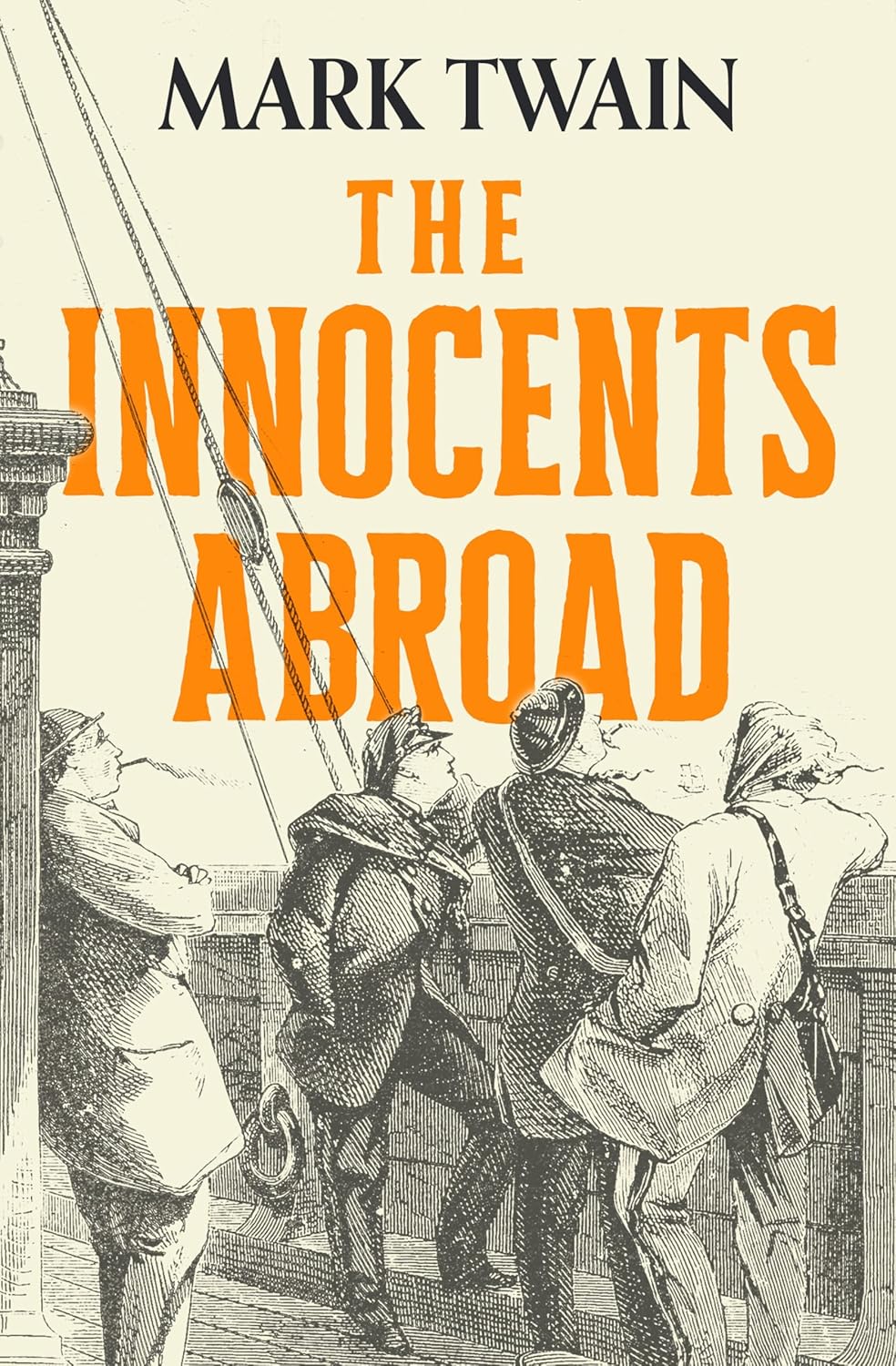
The Innocents Abroad (full title: The Innocents Abroad, or The New Pilgrims’ Progress) is Mark Twain’s first major book and one of his most famous and enduring travelogues. Published in 1869, it is a witty, irreverent, and often hilarious account of a five-month “pleasure excursion” to Europe and the Holy Land aboard the ship Quaker City in 1867.
Overview
Twain (then still known as Samuel Clemens) joined a group of mostly middle-class American tourists on the first large-scale American pleasure cruise to the Old World. The passengers called themselves “pilgrims,” but Twain quickly dubbed them “the innocents” because of their naïve expectations and sometimes comical behavior abroad.
The book is structured as a series of letters Twain originally wrote for American newspapers. It follows the voyage from New York through the Mediterranean, stopping at ports in Europe (Spain, France, Italy, Greece), the Black Sea, and the Holy Land (modern-day Israel, Palestine, Syria, and Lebanon), before returning home via Egypt.
What Makes It Special
Twain’s sharp, satirical eye turns what could have been a dry travel diary into a lively, entertaining masterpiece. He skewers:
- The pretensions of his fellow American tourists
- The hypocrisies and tourist traps of the Old World
- Romanticized notions of Europe and the Holy Land
- The gap between expectation and reality (the “sublime” ruins often turn out to be disappointing piles of stones)
At the same time, he shows genuine awe and curiosity. His descriptions of Venice at night, the Coliseum under moonlight, and the Sea of Galilee are lyrical and memorable.Some of the most famous sections include:
- His irreverent visit to the Holy Land and his honest disappointment with many biblical sites
- The comic encounters with aggressive guides and souvenir sellers
- The hilarious “quarantine” episode in Genoa
- His running commentary on European art, culture, and aristocracy
Tone & Style
Twain’s voice is conversational, sarcastic, and full of dry humor. He pokes fun at everyone—including himself—while occasionally revealing a deeper sensitivity. The book is both travel writing and social satire, and it helped establish Twain as one of America’s greatest humorists.Why It Still Matters
- It is one of the best early examples of American travel writing.
- It captures the post-Civil War American fascination with (and superiority complex toward) Europe.
- It remains genuinely funny more than 150 years later.
- Many of Twain’s observations about tourism, cultural clash, and human nature feel surprisingly modern.
Who Should Read It
- Fans of Mark Twain and classic American literature
- Readers who enjoy travel writing with a strong personality
- Anyone who likes witty, observational humor
- People interested in 19th-century views of Europe and the Middle East
Note on editions: Many modern editions include the original illustrations. The 75th-anniversary or annotated versions add helpful context, but the plain text is still highly readable.
In short, The Innocents Abroad is Mark Twain at his funniest and most observant — a lively, irreverent journey through Europe and the Holy Land that helped define American travel writing and established Twain as a major literary voice. It’s both a time capsule and a timeless comedy of manners.
If you enjoy witty travelogues or classic American humor, this book is a must-read.