
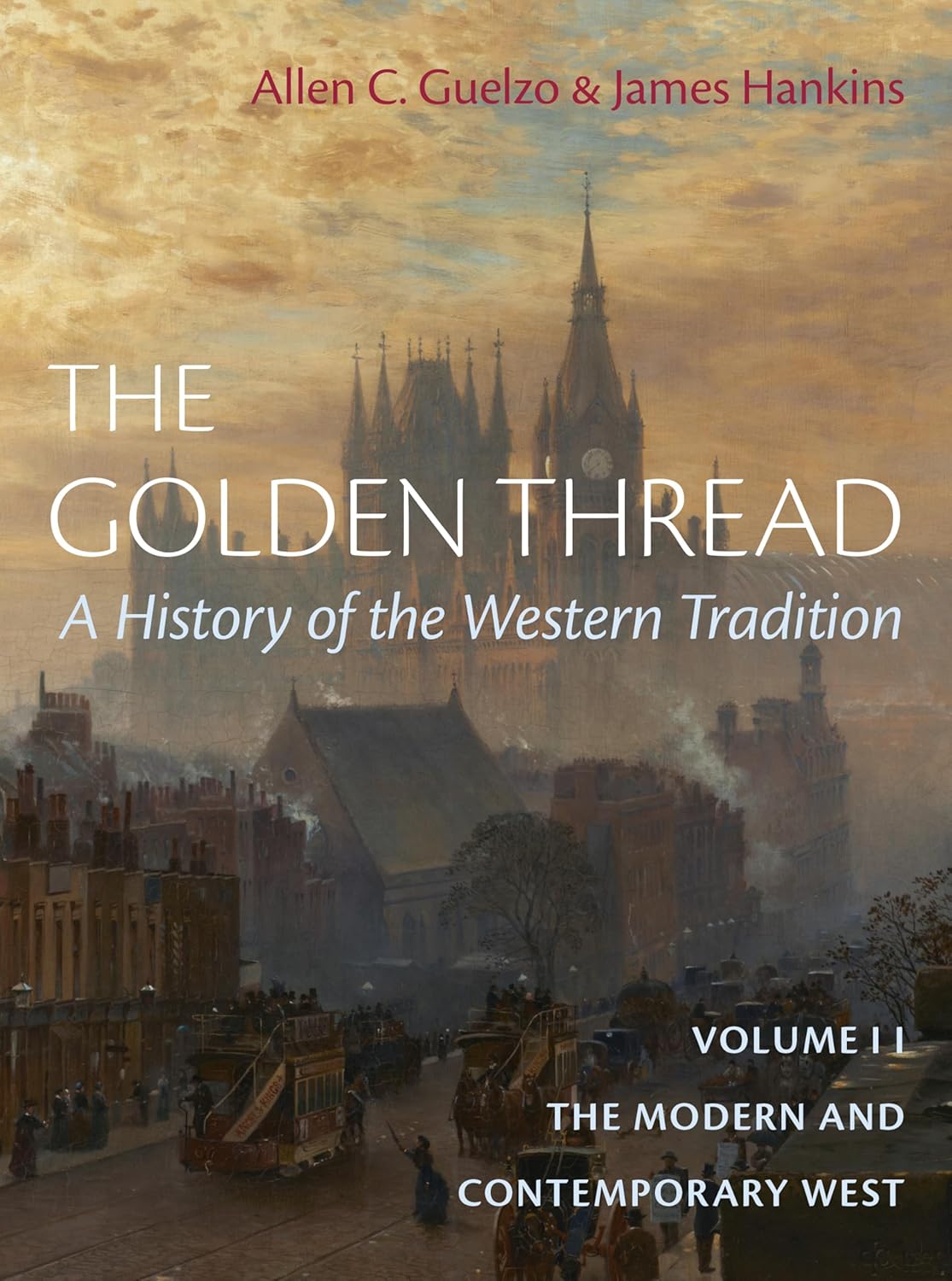
The Golden Thread: A History of the Western Tradition, Volume II: The Modern and Contemporary West by Richard Landes is the second volume of a sweeping, ambitious two-part history of Western civilization. Published in early 2026 by Encounter Books, this volume covers roughly 1500 to the present day, tracing the “golden thread” of ideas, institutions, and values that Landes believes have made the West distinctive: individual dignity, rule of law, scientific inquiry, self-criticism, and the belief in progress through reason and reform.
Plot Overview
Landes picks up where Volume I (covering antiquity through the Renaissance) left off. He argues that the modern West emerged from a unique fusion of classical heritage, Judeo-Christian ethics, and medieval developments (universities, legal traditions, the notion of consent in governance). The narrative moves through six major phases:
- The Early Modern Explosion (1500–1789)
The Scientific Revolution, Reformation, and Enlightenment lay the foundations. Landes highlights Copernicus, Galileo, Newton, Locke, Montesquieu, and Voltaire. He emphasizes how Protestant emphasis on individual conscience and literacy, combined with the printing press, fueled rapid intellectual and economic change. The rise of nation-states, capitalism, and the idea of rights are presented as deliberate breaks from older hierarchical models. - The Age of Revolution (1776–1848)
The American and French Revolutions are twin births of modern politics. Landes contrasts the U.S. success (constitutional limits, federalism, Protestant civic culture) with the French descent into Terror and dictatorship. He sees 1848 as a failed “springtime of peoples” that nevertheless spread liberal and nationalist ideas across Europe. - The Long Nineteenth Century (1848–1914)
Industrialization, imperialism, and the triumph of science create unprecedented wealth and power. Landes celebrates the spread of democracy, abolition of slavery, women’s suffrage movements, and mass education. He also notes the dark side: colonialism, social Darwinism, and rising nationalism that set the stage for catastrophe. - The Catastrophic Twentieth Century (1914–1945)
World War I shatters the optimistic narrative. Total war, genocide (Armenian, Holocaust), and totalitarian regimes (Bolshevism, Fascism, Nazism) represent the gravest challenge to the golden thread. Landes argues these horrors were not inevitable products of Western values but betrayals of them—perversions of reason, science, and progress into tools of domination. - The Cold War and Recovery (1945–1989)
The West rebuilds through the Marshall Plan, NATO, the European integration project, and the economic miracles of West Germany, Japan, and Italy. Landes credits liberal democracy and market economies with defeating Soviet communism without direct war. He sees 1989 as a vindication of the thread: self-criticism, openness, and voluntary association ultimately outlasted coercion and ideology. - The Contemporary West (1989–present)
The book ends on a note of cautious optimism mixed with warning. The fall of the Berlin Wall and spread of democracy seemed to confirm Fukuyama’s “end of history.” Yet Landes identifies new threats: identity politics, cancel culture, declining birth rates, loss of confidence in Enlightenment values, and the rise of authoritarian rivals (China, Russia). He argues the golden thread is fraying—not from external attack alone, but from internal loss of faith in its own principles.
Character Dynamics and Development
Landes writes as a historian of ideas more than biography. Key figures appear as carriers of the thread:
- Locke and Montesquieu (liberty and checks on power)
- Kant and Mill (autonomy and free speech)
- Lincoln and Churchill (moral clarity in crisis)
- Solzhenitsyn and Havel (resistance to totalitarianism)
He portrays the West as a self-correcting civilization that repeatedly faces crises of confidence but finds renewal through debate, reform, and return to core principles.
Key Themes
- The West is exceptional—not because of racial or cultural superiority, but because of a rare combination of values that prize individual dignity, empirical reason, and peaceful self-criticism.
- Progress is real but fragile; it requires constant defense against both external enemies and internal decadence.
- The 20th century’s horrors were not the logical outcome of Western values but betrayals of them.
- Today’s crisis is spiritual and intellectual: loss of belief in truth, merit, and universal human rights.
The tone is erudite, passionate, and occasionally polemical. Landes defends the Western tradition without nostalgia or triumphalism. He acknowledges flaws (slavery, imperialism, sexism) but insists they were overcome by the very principles critics often attack.
In short, this is a bold, thoughtful read. It defends the idea that the modern and contemporary West represents humanity’s best hope for freedom, prosperity, and dignity. It challenges both uncritical boosters and relentless critics. Perfect for readers who want a big-picture history of ideas that shaped—and still shape—the modern world.