
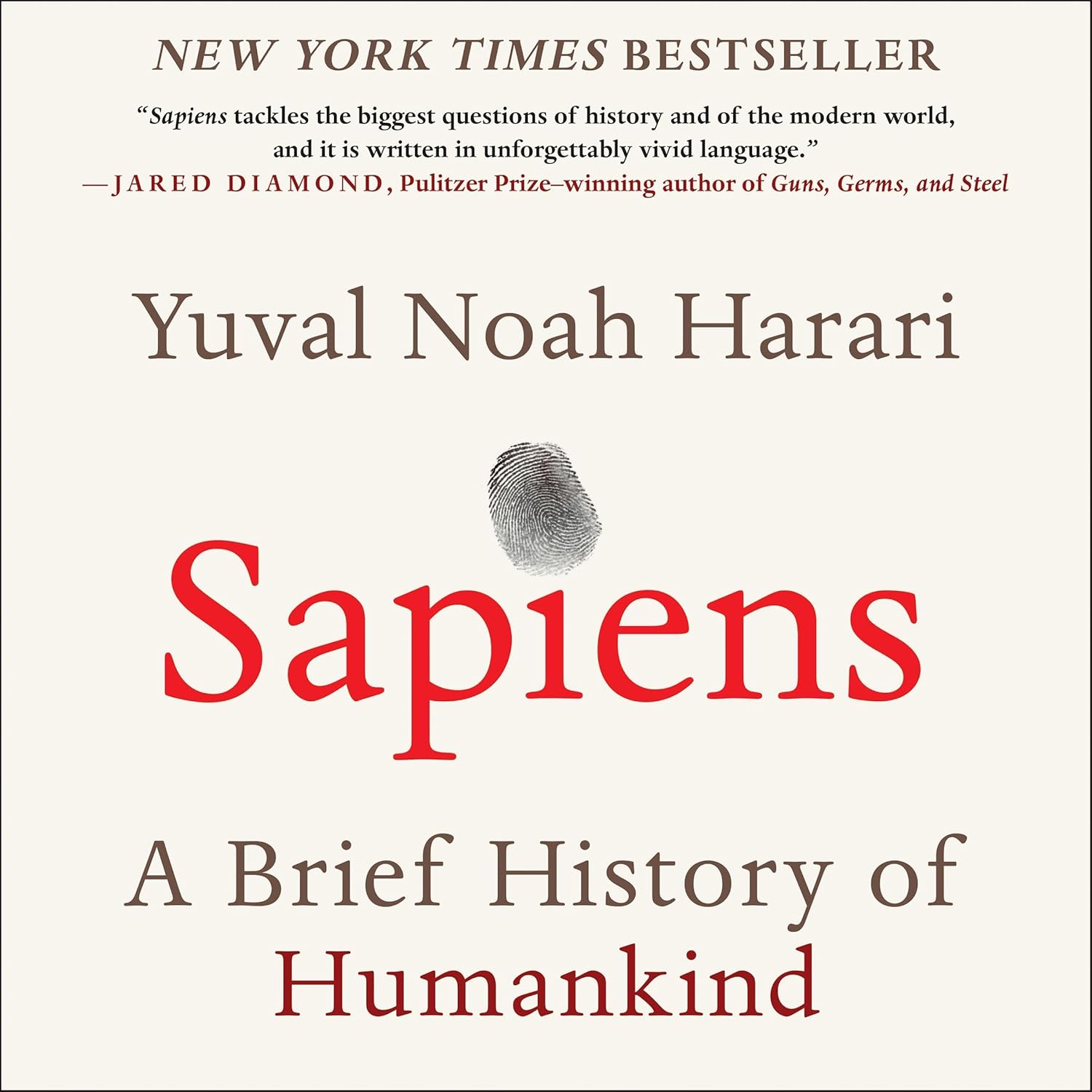
Sapiens: A Brief History of Humankind by Yuval Noah Harari is a sweeping, thought-provoking bestseller first published in 2011 (English edition 2014). It remains one of the most influential popular history books of the 21st century, selling millions of copies worldwide and translated into more than 65 languages. The book offers a grand narrative of Homo sapiens from the Stone Age to the present day—and speculates boldly about our future.
Plot Overview (Four Major Revolutions)
Harari structures human history around four transformative revolutions:
- Cognitive Revolution (c. 70,000–30,000 years ago)
Around 70,000 years ago, Homo sapiens developed new cognitive abilities—most importantly, complex language and the capacity to create and believe in shared fictions (myths, gods, nations, money, human rights). This allowed large groups of strangers to cooperate flexibly. No other animal can do this at sapiens scale. The revolution enabled sapiens to outcompete Neanderthals and other human species, spread across the globe, and drive most large mammals to extinction. - Agricultural Revolution (c. 12,000–3,000 BCE)
Often called “the worst mistake in the history of the human race,” the shift from foraging to farming produced more food per hectare but worsened quality of life for most people. Farmers worked longer hours, ate less varied diets, lived closer together (spreading disease), and became dependent on crops that could fail. Social hierarchies, private property, and inequality emerged. Harari argues that wheat domesticated humans, not the other way around. - Unification of Humankind (c. 1000 BCE–1500 CE)
Money, empires, and universal religions created global networks. Money is the most successful fiction ever invented—everyone trusts it. Empires spread languages, laws, and technologies. Religions (Christianity, Islam, Buddhism) gave millions a shared story. By the early modern period, most humans lived inside one of three cultural spheres: Christian, Muslim, or Chinese-Confucian. - Scientific Revolution (c. 1543–present)
The willingness to admit ignorance (“I don’t know”) combined with mathematics, experimentation, and capitalism unleashed unprecedented power. Science and technology created modern medicine, industrialization, nuclear weapons, computers, and genetic engineering. Harari argues this revolution is still unfolding—and it may soon allow us to upgrade humans into something new (cyborgs, super-humans, or even non-organic entities).
Key Themes and Arguments
- Shared fictions rule the world — Large-scale cooperation depends on collective myths: religion, nation-states, corporations, human rights, money. These are not “true” in a biological sense but extremely powerful.
- Humans are not the pinnacle of creation — We are just one species that happened to win the evolutionary lottery through imagination and cooperation.
- History has no direction or meaning — There is no guarantee of progress; empires rise and fall, ideologies come and go.
- Modernity is built on ignorance — Science advances by embracing doubt; capitalism thrives on reinvestment rather than hoarding.
- The future is radically uncertain — Biotechnology, artificial intelligence, and dataism (the belief that data flows are the highest value) may end the era of Homo sapiens as we know it.
Style and Reception
Harari writes in clear, witty, sometimes provocative prose. He uses vivid analogies (wheat domesticating humans, money as the most universal religion) and avoids academic jargon. Each chapter blends big ideas with surprising facts—why bankers love debt, how empires create gods, why chickens outnumber humans.
Critics praise the book’s ambition, readability, and ability to make readers rethink everything from capitalism to animal rights. Detractors argue it oversimplifies complex topics, cherry-picks evidence, and occasionally slips into sweeping generalizations or Eurocentrism. Harari himself calls it a “big history” meant to provoke thought, not deliver final truth.
In short, this is a bold, mind-expanding read. It compresses 100,000 years of human history into one gripping story and leaves you asking: What stories will we tell next—and what will they make us become? Perfect for anyone curious about the deep forces that shaped our species and where we might be headed.