
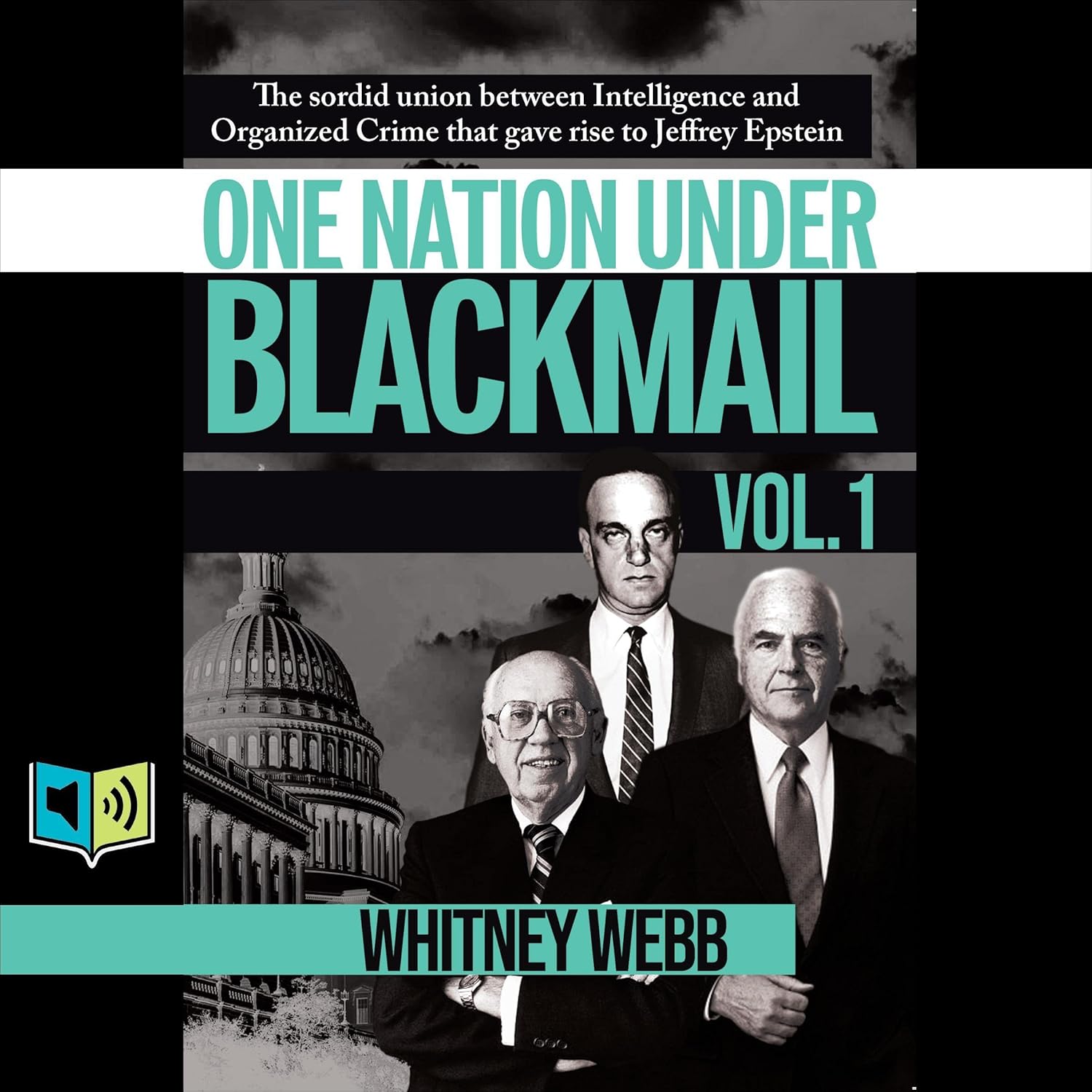
One Nation Under Blackmail, Vol. 1: The Sordid Union Between Intelligence and Crime that Gave Rise to Jeffrey Epstein by Whitney Webb is a dense, exhaustively researched investigative work. Published in September 2022, this first volume (of a two-part series) traces the decades-long convergence of organized crime, U.S. intelligence agencies, and financial power structures that created the conditions for figures like Jeffrey Epstein to operate with apparent impunity.
Overview
Webb argues that Epstein was not an isolated predator but the visible endpoint of a much older, systemic pattern. The book shows how post-World War II U.S. intelligence deliberately partnered with mobsters, arms traffickers, money launderers, and sexual blackmail operators to advance geopolitical and economic goals. These alliances were never fully dismantled; they evolved and were institutionalized.
The volume is organized chronologically and thematically:
- Pre- and Post-War Foundations (1930s–1950s)
Webb begins with Meyer Lansky’s National Crime Syndicate and its cooperation with the Office of Naval Intelligence and the OSS during World War II (Operation Underworld). After the war, these relationships continued through the CIA’s use of mob-linked figures for anti-communist operations, money laundering via offshore banks, and covert funding of regime change. - The Cold War Blackmail Networks (1950s–1970s)
The book examines key players and institutions:- Lewis Rosenstiel (liquor baron and alleged pedophile who hosted compromising parties).
- Roy Cohn (McCarthy’s chief counsel, Trump’s early mentor, and Rosenstiel’s protégé).
- The Permindex / Centro Mondiale Commerciale network (linked to Clay Shaw, the CIA, and the assassination of JFK).
- The role of organized crime in the financing of Israel’s nuclear program and in arms trafficking.
Webb documents how sexual blackmail became a standard intelligence tool—used by both the CIA and the FBI (under Hoover)—to control politicians, businessmen, and foreign leaders.
- The 1980s–1990s Escalation
The narrative covers:- The Savings & Loan scandal and its ties to CIA/money-laundering networks.
- The Iran-Contra affair and the role of private arms dealers and drug traffickers.
- The rise of the Mega Group (a network of ultra-wealthy Jewish-American philanthropists with ties to organized crime and intelligence).
- Leslie Wexner’s relationship with Epstein (and the transfer of power of attorney over Wexner’s fortune to Epstein in the 1990s).
- The Epstein Nexus
The final chapters focus on Epstein’s early career, his unexplained wealth, his ties to intelligence-linked figures (Ghislaine Maxwell’s father Robert Maxwell, a confirmed Mossad asset), and the role of the Mega Group in funding and protecting him. Webb shows how Epstein’s operation followed the same playbook: sexual blackmail of powerful men, hidden cameras, offshore money flows, and protection from prosecution.
Key Arguments & Evidence
- Epstein was not a lone operator; he was enabled by a long-standing “sordid union” between U.S. intelligence, organized crime, and elite financial interests.
- Sexual blackmail has been a deliberate intelligence tactic since the 1950s (Hoover’s “sex files,” Cohn’s parties, the Profumo affair as a British parallel).
- Many of the same networks that protected Epstein also facilitated other high-profile scandals and covert operations.
- Webb relies heavily on declassified documents, court records, investigative journalism (from outlets like The Village Voice, Miami Herald, and MintPress News), and secondary sources. She avoids speculation where evidence is thin but connects dots that mainstream coverage often ignores.
Style
The writing is dense and heavily footnoted—more investigative report than narrative page-turner. It demands careful reading. Supporters praise its depth and courage; critics argue it sometimes overreaches on connections or gives insufficient weight to counter-evidence.The tone is sober and outraged without being sensationalist. Webb lets the documents speak; she rarely editorializes.
Bottom Line
Volume 1 is not light reading. It is a 500+ page deep dive into the historical infrastructure of elite impunity, blackmail, and intelligence-crime collusion. Epstein is the endpoint, not the origin. The book leaves readers with a darker view of 20th-century power structures—and raises troubling questions about what has and has not changed in the 21st century.
If you are interested in Epstein’s backstory, organized crime–intelligence ties, or the hidden architecture of influence, this is one of the most comprehensive (and controversial) works available. Volume 2 picks up closer to the present and focuses more directly on Epstein, Maxwell, and their network.