
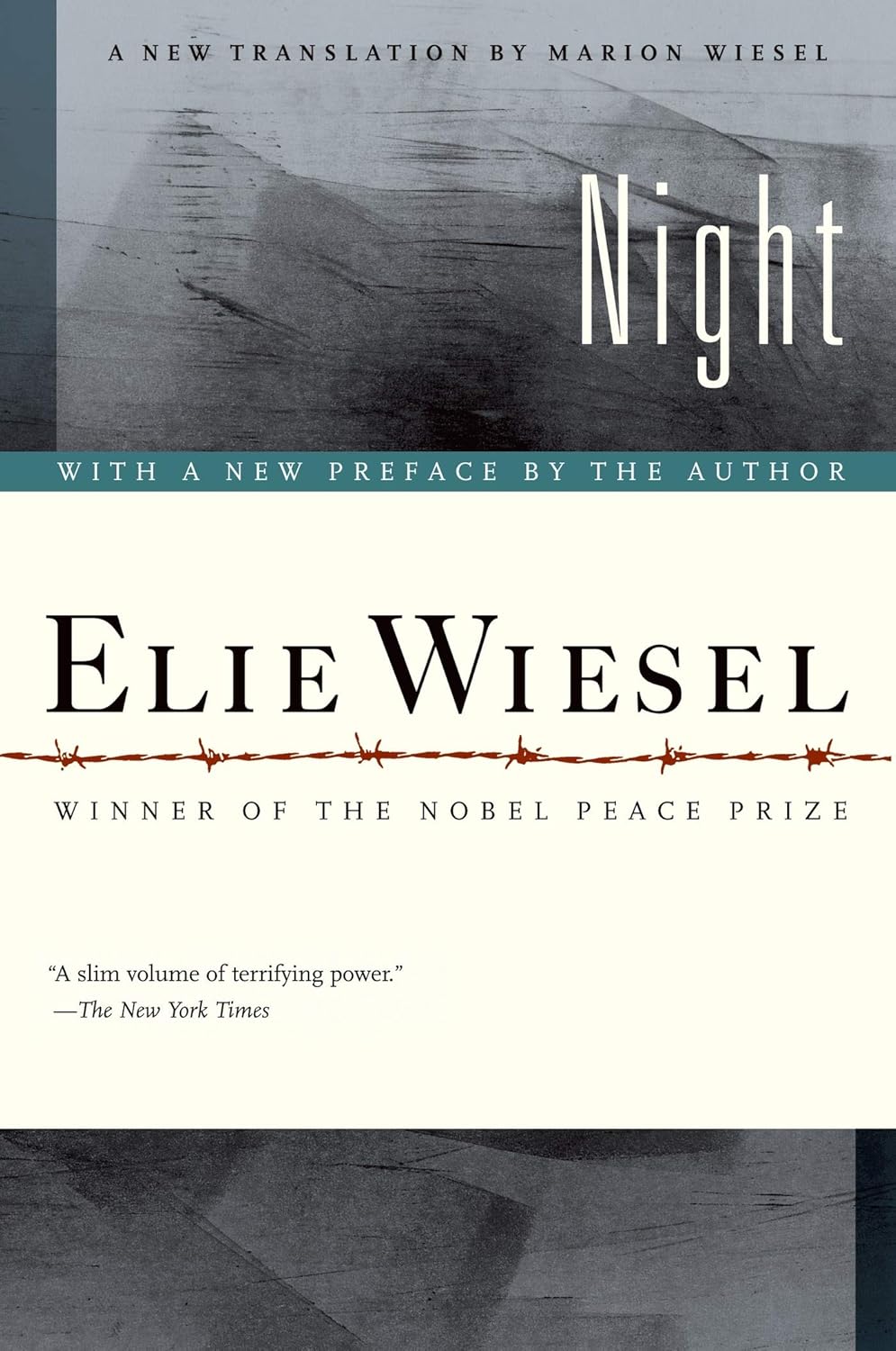
Night
Introduction
Night (La Nuit, 1958) is Elie Wiesel’s harrowing, autobiographical account of his survival through the Holocaust. At just 15–16 years old, Wiesel—along with his family—was deported from Sighet, Transylvania, to Auschwitz-Birkenau, then Buchenwald. The slim volume (~120 pages in most editions) is the first and most famous part of his Night trilogy. Written in sparse, unflinching prose, it stands as one of the most powerful testimonies of the Shoah. Wiesel, who won the Nobel Peace Prize in 1986, called it not a novel but “a deposition”—a witness statement meant to preserve memory and confront humanity with the abyss. In 2026, as Holocaust survivors dwindle and denialism resurfaces, Night remains essential, raw, and devastatingly relevant.
Content and Structure
The narrative follows a tight chronological arc from 1944 to liberation in 1945, told in first person with almost clinical restraint.
- Sighet, 1944: Life seems normal until Hungarian Jews are ghettoized. Moshe the Beadle, a foreign Jew who escaped earlier massacres, returns with warnings no one believes. Deportations begin; the family is crammed into cattle cars.
- Auschwitz-Birkenau: Arrival, selection, the smell of burning flesh. Elie and his father are separated from his mother and younger sister Tzipora (whom they never see again). The boy witnesses crematoria, hangings, medical experiments, and the slow erosion of humanity.
- Buna, Gleiwitz, Buchenwald: Forced labor, death marches in snow, starvation, typhus. Wiesel describes the death of his father—his final protector—through illness, beatings, and abandonment. The book ends with liberation by American troops in April 1945: Elie, barely alive, stares at his reflection and sees a corpse gazing back.
The structure is linear and concise—no lengthy digressions. Wiesel focuses on personal experience rather than broad history, making the horror intimate. Key moments include the hanging of a young boy (“pipel”) that shatters faith, the “selection” rituals, and Elie’s growing detachment from God and morality.
Key Themes and Takeaways
Central is the loss of faith: “Never shall I forget those flames which consumed my faith forever.” Wiesel grapples with God’s silence amid unimaginable evil. Other themes include dehumanization (prisoners reduced to numbers), the fragility of family bonds under extreme pressure, survival’s moral cost, and the burden of memory. The title Night symbolizes spiritual darkness, the eclipse of humanity, and the long shadow cast over survivors. Wiesel shows how ordinary people become perpetrators or bystanders, and how victims can lose their own humanity in the struggle to live.The book is not about heroism—it’s about endurance, guilt, and the impossibility of fully conveying what happened.
Strengths and Criticisms
Strengths: Its brevity amplifies impact; every sentence carries weight. The restrained style avoids melodrama, letting facts horrify. Wiesel’s voice—young, questioning, broken—feels authentic and timeless. It’s taught worldwide as literature, history, and moral philosophy.Criticisms: Some readers find it too bleak, lacking hope or redemption. The sparse detail on broader context (politics, resistance) can feel narrow. Early editions were even shorter; some prefer the expanded 2006 translation with a new preface reflecting on memory’s fragility.
Conclusion
Night is not an easy read—it’s meant to wound and awaken. Wiesel achieves what few can: he makes the unimaginable feel real without exploiting it. At once memoir, elegy, and warning, it demands we remember so such darkness never returns. Rated 5/5—not for enjoyment, but for necessity. Essential for anyone studying the Holocaust, human rights, or the limits of faith and morality. Read it, then read it again. Silence, Wiesel reminds us, is the greatest danger.