
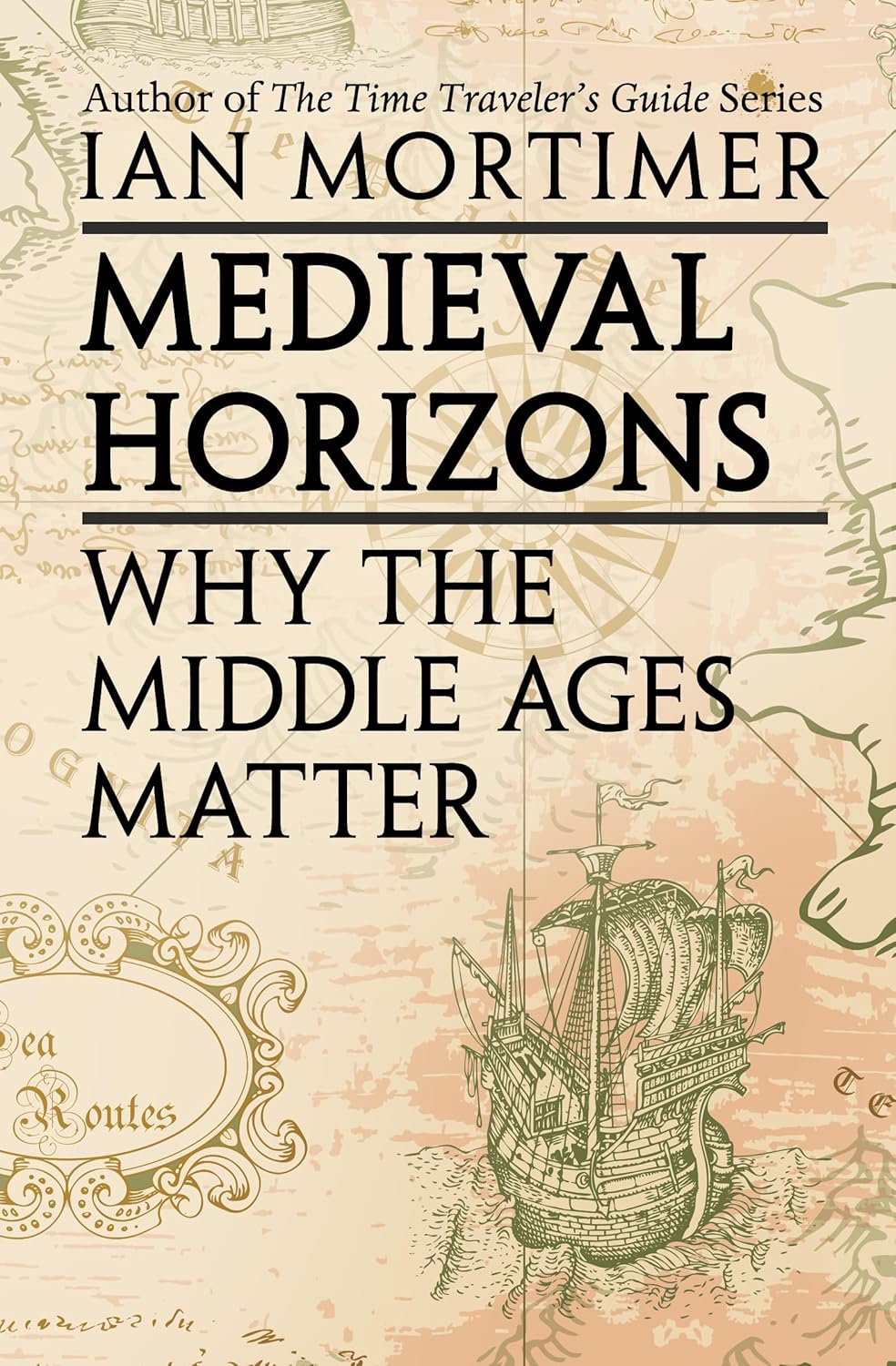
Medieval Horizons: Why the Middle Ages Matter by Ian Mortimer is a compelling and thought-provoking book that challenges the common modern perception of the Middle Ages as a “dark,” backward, or irrelevant period. Published in 2023 (with continued strong interest in 2026), it argues that the medieval period (roughly 1000–1500 CE) was not a stagnant thousand-year slump between the fall of Rome and the Renaissance, but a dynamic, transformative era that laid the essential foundations for the modern world.
Core Thesis
Mortimer’s central argument is that the Middle Ages were a time of profound and rapid change — often more revolutionary than many people realize. He identifies several key “horizons” (major shifts in how people thought, lived, and organized society) that still shape our lives today:
- The rise of individualism and personal identity
- The development of a money-based economy and sophisticated financial systems
- The birth of the nation-state and concepts of sovereignty
- Major advances in science, technology, and medicine (often overlooked)
- Changing attitudes toward time, space, and human potential
- The evolution of law, rights, and governance
Rather than viewing the era as uniformly “medieval” (a term that has become synonymous with backwardness), Mortimer shows it as a series of overlapping revolutions that gradually dismantled the old Roman and early medieval world and built the foundations of modernity.
Structure & Content
The book is organized thematically rather than strictly chronologically. Mortimer examines different aspects of medieval life and thought:
- How people perceived time (from cyclical agricultural rhythms to more linear, measurable time)
- The transformation of space and travel (from dangerous, localized journeys to greater mobility and exploration)
- The shift from status-based to contract-based society
- The growth of literacy, education, and intellectual curiosity
- Changing ideas about the self, the soul, and human dignity
- The development of parliaments, legal systems, and representative government
He supports his points with vivid examples from across Europe (England, France, Italy, the Holy Roman Empire, etc.) and draws on a wide range of sources — chronicles, letters, legal documents, art, and archaeology.
Style & Tone
Mortimer writes with clarity, wit, and infectious enthusiasm. He is a skilled storyteller who makes complex historical developments accessible without dumbing them down. The tone is optimistic and corrective — he wants to rescue the Middle Ages from centuries of prejudice and caricature (the “Dark Ages” myth) while still acknowledging its brutality, superstition, and inequalities.
Why It Matters
The book makes a strong case that many things we take for granted today — individual rights, scientific inquiry, constitutional government, a market economy, and even the idea that the future can be better than the past — have deep medieval roots. Understanding this period helps us better appreciate both the achievements and the unfinished work of the modern world.
Reception
Historians and general readers have praised it for its fresh perspective, engaging writing, and ability to challenge long-held assumptions. It is often recommended alongside books like The Time Traveller’s Guide to Medieval England (also by Mortimer) for anyone who wants a more nuanced and human view of the Middle Ages.
In short, Medieval Horizons is an excellent, readable book that convincingly argues the Middle Ages were far more dynamic, innovative, and foundational to our modern world than most people realize. It is ideal for history enthusiasts, students, or anyone who wants to understand where many of our contemporary ideas and institutions actually came from.