
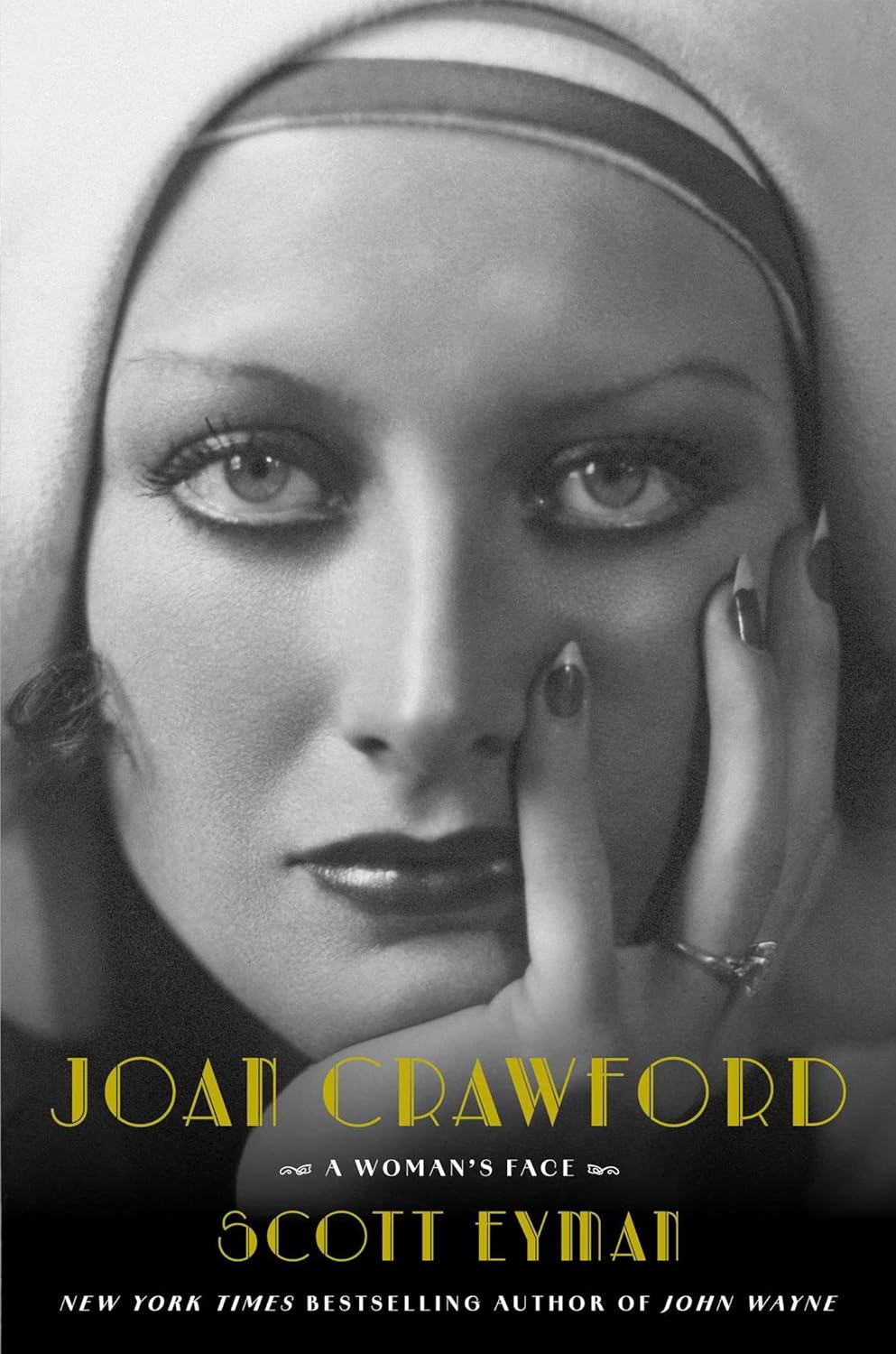
Book Review: Joan Crawford: A Woman’s Face by Scott Eyman
Introduction
Scott Eyman, the acclaimed film historian and New York Times bestselling biographer (John Wayne, Cary Grant), delivers what many call the definitive modern biography of Joan Crawford in Joan Crawford: A Woman’s Face (Simon & Schuster, 2025). At ~464 pages, this richly researched hardcover draws on never-before-seen documents, photos from the Crawford estate, interviews with friends and relatives, and extensive archival material. Released amid renewed interest in Golden Age Hollywood and reevaluations of complex female icons, the book reframes Crawford—not as the villain of Mommie Dearest lore, nor a saint, but as a fiercely self-made survivor whose ambition, talent, and contradictions defined an era. Eyman approaches her with the same insightful, balanced analysis he brought to Wayne and Grant, emphasizing her transformative genius onscreen and off. In early 2026, with Crawford’s films streaming and her legacy debated, this comprehensive portrait feels essential and timely.
Content and Structure
The biography follows a chronological arc, tracing Crawford’s life from impoverished origins to Hollywood immortality.
- Early years: Born Lucille Fay LeSueur in 1904 or 1906 (dates disputed), she endured a harsh childhood—abandonment by her father, stepfather abuse, laundry work, and dance halls. Eyman details her reinvention: adopting the name Joan Crawford via a 1925 fan contest and rising through silent films at MGM.
- Stardom and evolution: Crawford’s ascent in the 1930s–1940s—flapper roles, shop-girl melodramas, then mature triumphs like Mildred Pierce (1945 Oscar win)—is chronicled with attention to her genre versatility: romance, noir (A Woman’s Face, 1941), westerns (Johnny Guitar), musicals (Torch Song), and late cameos (even a Spielberg-directed TV spot). Eyman analyzes her “self-made” persona: rigorous self-training, plastic surgery rumors, and relentless work ethic.
- Personal life and controversies: Marriages (four, including Douglas Fairbanks Jr. and Phillip Terry), adopted children (Christina and Christopher), and the infamous Mommie Dearest allegations receive measured treatment. Eyman acknowledges abusive parenting claims (e.g., tying Christopher to bed) but contextualizes them amid Crawford’s trauma, alcoholism struggles, and the era’s pressures on women stars. He interviews family and friends for nuance, separating myth from reality.
- Later years: Decline in the 1950s–1970s, Pepsi board role (via fourth husband Alfred Steele), and reclusive Manhattan end in 1977.
The structure interweaves career highs with personal lows, using primary sources to humanize without excusing.
Key Themes and Takeaways
Central is self-transformation: Crawford as Hollywood’s ultimate “made” star—reinventing face, name, body, and image to survive poverty and sexism. Themes include ambition’s cost (isolation, addiction, fractured family), women’s agency in a male-dominated industry, the gap between screen persona and private pain, and legacy’s distortion by tabloids and posthumous accounts. Eyman celebrates her brilliance—commanding presence, emotional range—while confronting flaws, offering a fuller picture than prior biographies.
Strengths and Criticisms
Strengths: Groundbreaking access to estate materials yields fresh insights; Eyman’s prose is engaging, analytical, and passionate. Reviews (e.g., The New Yorker, WSJ) praise its clarity, enthusiasm, and balance—neither hagiography nor takedown. It’s richly anecdotal and visually evocative.Criticisms: Some find the treatment of child abuse allegations too lenient or brief. The length (464 pages) can feel dense for casual readers, and focus on career sometimes overshadows personal depth.
Conclusion
Joan Crawford: A Woman’s Face is a masterful, compassionate biography that restores nuance to an icon often reduced to caricature. Eyman reveals a dazzling, turbulent life shaped by grit, talent, and tragedy—proving Crawford was far more than “Mommie Dearest.” Highly recommended for film fans, Hollywood history buffs, or anyone interested in women’s ambition in mid-century America. Rated 4.6/5 for research, insight, and readability. A landmark addition to classic Hollywood scholarship.