
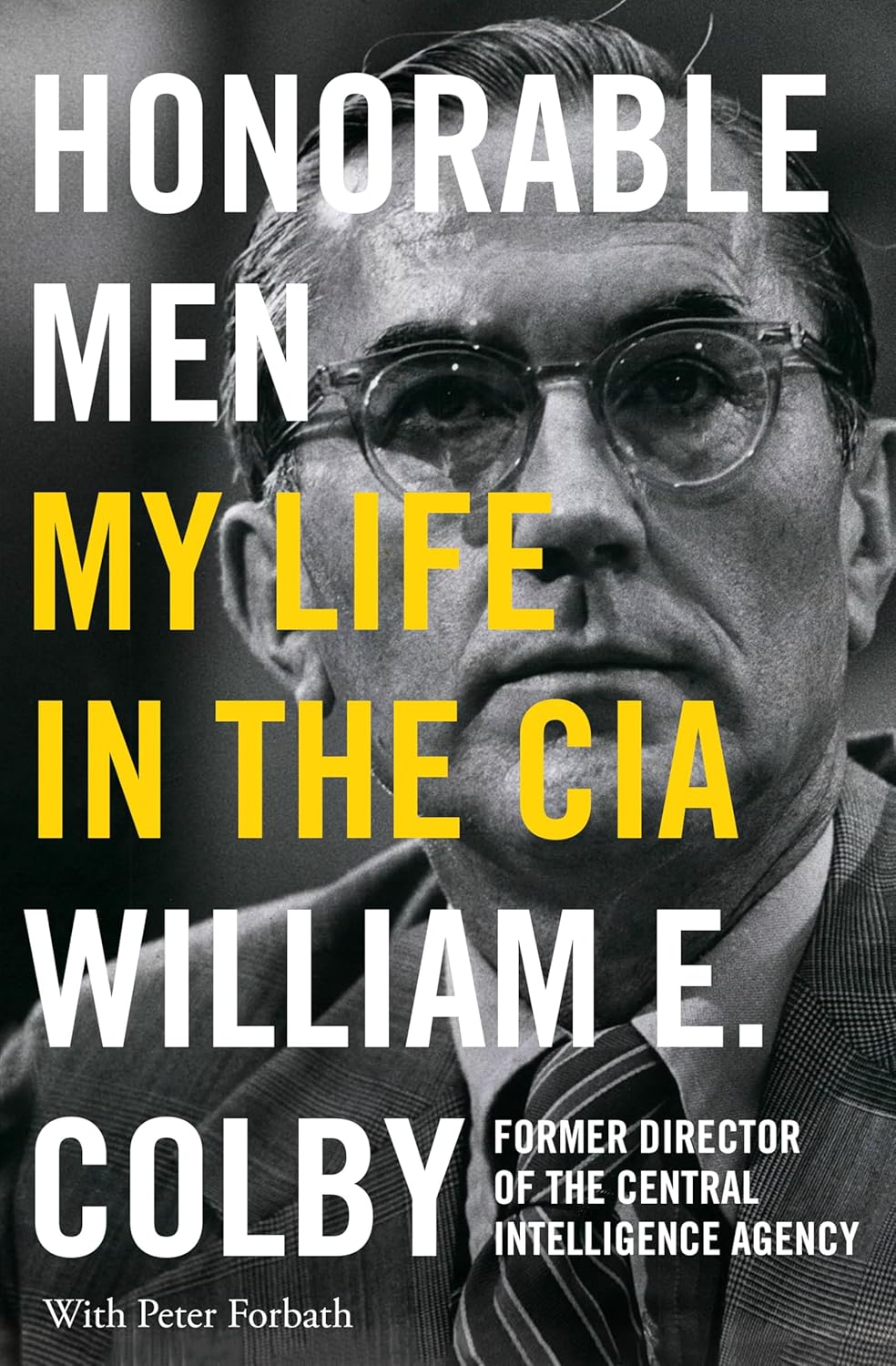
Honorable Men: My Life in the CIA by William E. Colby (with Peter Forbath) is a candid, introspective memoir by one of the most controversial directors of the Central Intelligence Agency. First published in 1978, it remains one of the most significant insider accounts of the CIA during the Cold War. The current edition (with a new foreword or afterword in some reprints) continues to be widely read for its unvarnished look at intelligence work, moral dilemmas, and the agency’s turbulent 1970s.
Plot Overview
William Colby served in the OSS during World War II, parachuting behind enemy lines in occupied France and Norway. After the war he joined the newly formed CIA in 1950. His career spanned the agency’s formative decades:
- Early postings in Stockholm and Rome during the height of the Italian Communist threat.
- Chief of the Far East Division during the Vietnam era, where he oversaw the controversial Phoenix Program—a campaign to neutralize the Viet Cong infrastructure through intelligence, interrogation, and targeted operations.
- Deputy Director for Plans (covert action) under Richard Helms.
- Director of Central Intelligence from September 1973 to January 1976 under Presidents Nixon and Ford.
The memoir traces Colby’s journey from idealistic wartime operative to the man who inherited the agency at its lowest point. In 1973–1975 the CIA faced a cascade of scandals: Watergate-related revelations, the exposure of domestic spying (Operation CHAOS), assassination plots against foreign leaders, MKULTRA mind-control experiments, and illegal mail-opening programs. Colby cooperated fully with congressional investigations (the Church and Pike Committees), declassifying thousands of documents and publicly acknowledging past abuses. His openness earned him enemies inside the agency and admiration from reformers outside.
Colby frames his decisions as a matter of honor: the CIA must serve the Constitution, not hide from democratic oversight. He defends much of the agency’s work—especially covert action against Soviet influence—but admits grave errors. The book ends with his firing by President Ford in late 1975 (widely seen as a scapegoating move to placate critics) and his reflection on the future of American intelligence in a more transparent era.
Character Dynamics and Development
Colby portrays himself as a pragmatic Catholic patriot who believed intelligence was essential to freedom but must remain subordinate to law and morality. He contrasts sharply with predecessors like Allen Dulles (charismatic but secretive) and Richard Helms (loyal but guarded). Colby emerges as a man of conscience who chose disclosure over institutional self-protection.
Key figures include:
- Presidents Nixon and Ford (distant and politically driven).
- Henry Kissinger (dominant in foreign policy, often at odds with Colby).
- Richard Helms and James Schlesinger (predecessors who shaped—and sometimes shielded—the agency).
- Frank Church and Otis Pike (committee chairmen who investigated the CIA; Colby cooperated while trying to limit damage).
The memoir is notably restrained in personal attacks. Colby criticizes policies and decisions more than individuals.
Key Events and Themes
Major moments include:
- The Italian election operations of the 1940s–1950s.
- The Bay of Pigs aftermath and the shift to covert action in Southeast Asia.
- The Phoenix Program in Vietnam (Colby insists it saved lives by targeting infrastructure rather than indiscriminate killing, though critics called it an assassination program).
- The “Family Jewels” compilation of CIA misdeeds that Colby ordered in 1973.
- His testimony before Congress in 1975, widely seen as a turning point in intelligence oversight.
Central themes:
- The tension between secrecy and democracy.
- The moral cost of covert action.
- The necessity of intelligence in a dangerous world.
- Personal integrity versus institutional loyalty.
Colby writes in a measured, almost legalistic style—clear, factual, and reflective. He avoids sensationalism but does not shy away from hard truths.
In short, this is an essential, sobering read. A former CIA director recounts his life in the shadows of the Cold War and the painful reckoning of the 1970s. It defends the agency’s mission while admitting its failures. It remains a classic of intelligence literature—honest, principled, and still relevant to debates about oversight, ethics, and national security. Perfect for anyone interested in the CIA’s history, Vietnam-era policy, or the moral challenges of espionage.