
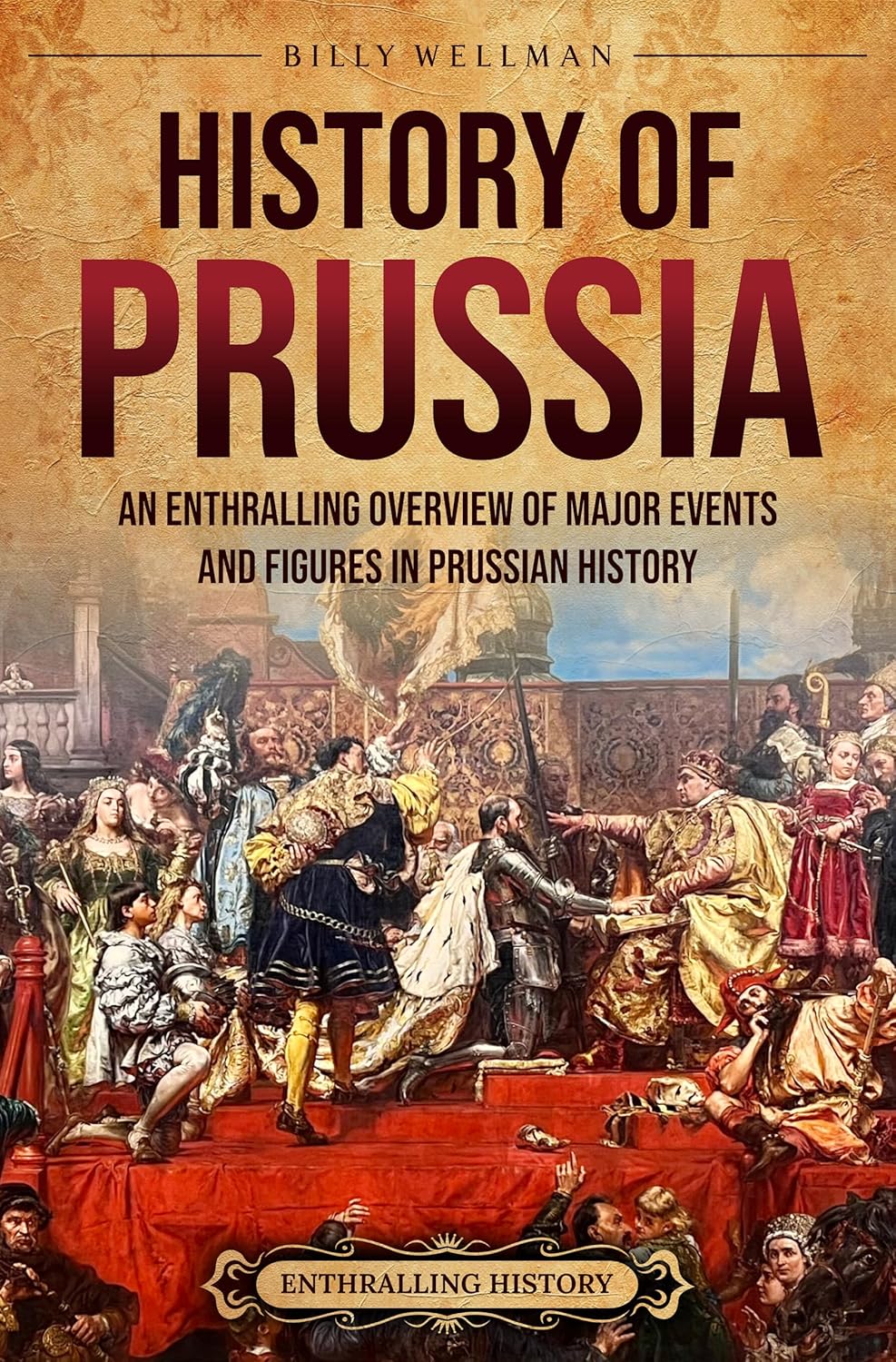
History of Prussia: An Enthralling Overview of Major Events and Figures in Prussian History (Europe) by Billy Wellman is a concise, engaging introduction to Prussia’s dramatic story. It came out in early 2026. The book covers the rise, peak, and fall of this influential state. It focuses on key moments and people who shaped Europe.
Plot Overview
Prussia started small. Old Prussians lived on the Baltic coast. They had unique rituals and pagan beliefs. Teutonic Knights conquered the area in the 13th century. They brought Christianity and German settlers. The Knights ruled as a strong order. In 1525, the last grand master secularized the land. It became the Duchy of Prussia under Polish rule.
The Hohenzollern family from Brandenburg gained control. In 1618, the duchy united with Brandenburg. This created Brandenburg-Prussia. The Thirty Years’ War hurt the land badly. But leaders rebuilt it strong. Frederick William, the Great Elector, grew the army and economy. He welcomed Huguenots after France’s Edict of Nantes ended. His son Frederick I became the first king in 1701. He crowned himself in Königsberg.
Prussia rose fast in the 18th century. Frederick the Great took the throne in 1740. He invaded Silesia right away. This started the War of the Austrian Succession. Prussia won key battles. It became a great power. Frederick fought in the Seven Years’ War too. He survived against big enemies. His reforms built a strong state. Prussia had a top army and good bureaucracy.
In the 19th century, Prussia led German unification. Napoleon crushed it in 1806 at Jena. But reforms followed. The army modernized. In 1813–1815, Prussia helped defeat Napoleon. Otto von Bismarck became key in the 1860s. He used smart wars to unite Germany. The Franco-Prussian War in 1870–1871 ended with victory. Wilhelm I became German emperor in 1871. Prussia was the heart of the new empire.
After World War I, Prussia became a state in the Weimar Republic. It lost power. In 1934, the Nazis took its control. After World War II, the Allies abolished Prussia in 1947. They saw it as a source of militarism.
Character Dynamics and Development
The Hohenzollern rulers drive the story. Frederick William I built a strong army. His son Frederick the Great became a legend. He was a military genius and enlightened ruler. He loved music and philosophy. Voltaire visited him. Frederick William III faced Napoleon. He reformed after defeat. Bismarck was clever and ruthless. He used wars and deals to unite Germany.
These leaders grew Prussia from a small state to a powerhouse. They balanced war with reforms. The book shows their strengths and flaws.
Key Events and Themes
The book moves through time. It covers the Teutonic conquest, the kingdom in 1701, Frederick the Great’s wars, Napoleonic defeat, Bismarck’s unification, and the end in 1947.
Themes include militarism and discipline. Prussia valued a strong army and order. It shows how one state shaped modern Germany. The book looks at how partitions and wars changed borders. It explores rise from weakness to power.
The tone is clear and exciting. It uses simple language. It tells the story like an adventure.In short, this is a fun, quick read. It covers Prussia’s wild history. From Baltic tribes to German empire. It shows how wars and leaders made a small land matter big. Great for beginners who want an enthralling overview of Prussian events and figures.