
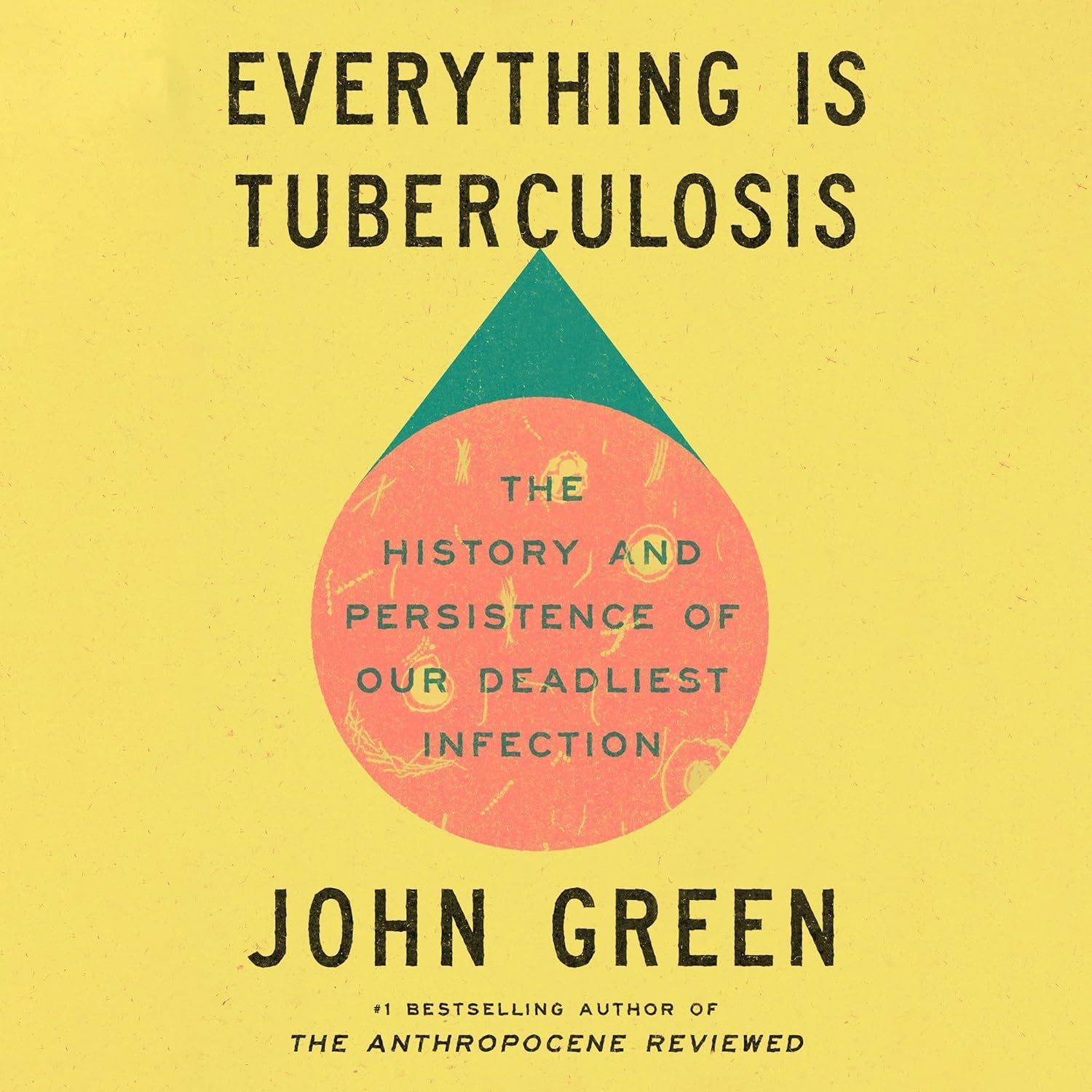
Everything Is Tuberculosis: The History and Persistence of Our Deadliest Infection by John Green is a gripping, deeply researched, and surprisingly personal exploration of humanity’s longest and most devastating relationship with a single pathogen. Published in March 2025, the book quickly became a bestseller and one of the most talked-about nonfiction titles of the year. Green—best known as the author of The Fault in Our Stars and co-creator of the educational YouTube channels Crash Course and Vlogbrothers—brings his signature blend of curiosity, humor, empathy, and clear-eyed storytelling to one of the oldest and deadliest diseases in human history.
Overview
The book is not a traditional medical history. Instead, it is structured as a narrative journey through time, science, society, and personal experience.
Green weaves together:
- The deep biological history of Mycobacterium tuberculosis (how it evolved, how it infects, why it is so hard to eradicate)
- Key moments in human encounters with TB: ancient evidence in Egyptian mummies, the Romantic-era “consumption” aesthetic, the 19th-century sanatorium movement, the discovery of the bacillus by Robert Koch in 1882, the development of antibiotics in the mid-20th century, and the rise of multidrug-resistant strains in the 21st century
- Global inequities: why TB remains the world’s deadliest infectious disease (killing ~1.5 million people annually even today), disproportionately affecting the poorest communities
- Personal stories: Green intersperses his own reflections on visiting TB wards in places like Peru and India, conversations with patients, doctors, and researchers, and the emotional toll of witnessing preventable suffering in the age of effective treatment
The title—“Everything Is Tuberculosis”—is both provocative and literal. Green argues that TB is not just a disease; it is a lens through which to see colonialism, poverty, racism, scientific progress, human resilience, and the limits of modern medicine. Wherever there has been inequality, overcrowding, malnutrition, or disrupted healthcare, TB has thrived.
Style & Tone
Green writes with warmth, wit, and intellectual humility. He is never dry or overly technical; he explains complex microbiology and epidemiology in ways that are clear and engaging. He frequently breaks the fourth wall, admits what he does not know, and shares moments of doubt, frustration, and hope. The prose is conversational yet precise—perfect for readers who want serious history and science without academic dryness.
The book is also deeply empathetic. Green spends significant time with people currently living with TB—patients in low-resource settings, doctors fighting resistant strains, activists pushing for better access to drugs. These encounters ground the history in the present and make the stakes feel urgent.
Key Arguments
- TB is ancient and intimately tied to human civilization: evidence of infection dates back at least 9,000 years, and the disease exploded with urbanization and colonialism.
- Progress against TB has been real but wildly uneven: antibiotics and shorter regimens exist, yet millions still die because of poverty, stigma, weak health systems, and lack of political will.
- Drug resistance is a growing crisis: multidrug-resistant TB (MDR-TB) and extensively drug-resistant TB (XDR-TB) are spreading, partly because of underinvestment in new drugs and poor adherence in fragile health systems.
- TB is a social disease as much as a biological one: it thrives where inequality, overcrowding, and malnutrition exist—and those conditions are worsening in many parts of the world.
- We have the tools to end TB as a public-health crisis, but we lack the global commitment to do so.
The book received widespread acclaim for its blend of rigorous research, narrative drive, and moral clarity. Reviewers called it “riveting,” “heartbreaking,” and “essential.” It was praised for making a complex scientific and historical subject feel urgent and human. Some critics noted occasional repetition or a slightly didactic tone in places, but most agreed it succeeds as both education and advocacy.
In short, Everything Is Tuberculosis is a rare book: a serious work of history and science that reads like a story, feels like a call to action, and leaves you both informed and unsettled. It is essential reading for anyone interested in public health, infectious disease, inequality, or the long arc of human struggle against one of our oldest enemies. Green makes the case that TB is not a disease of the past—it is a disease of our present failures, and therefore a mirror we cannot afford to ignore.