
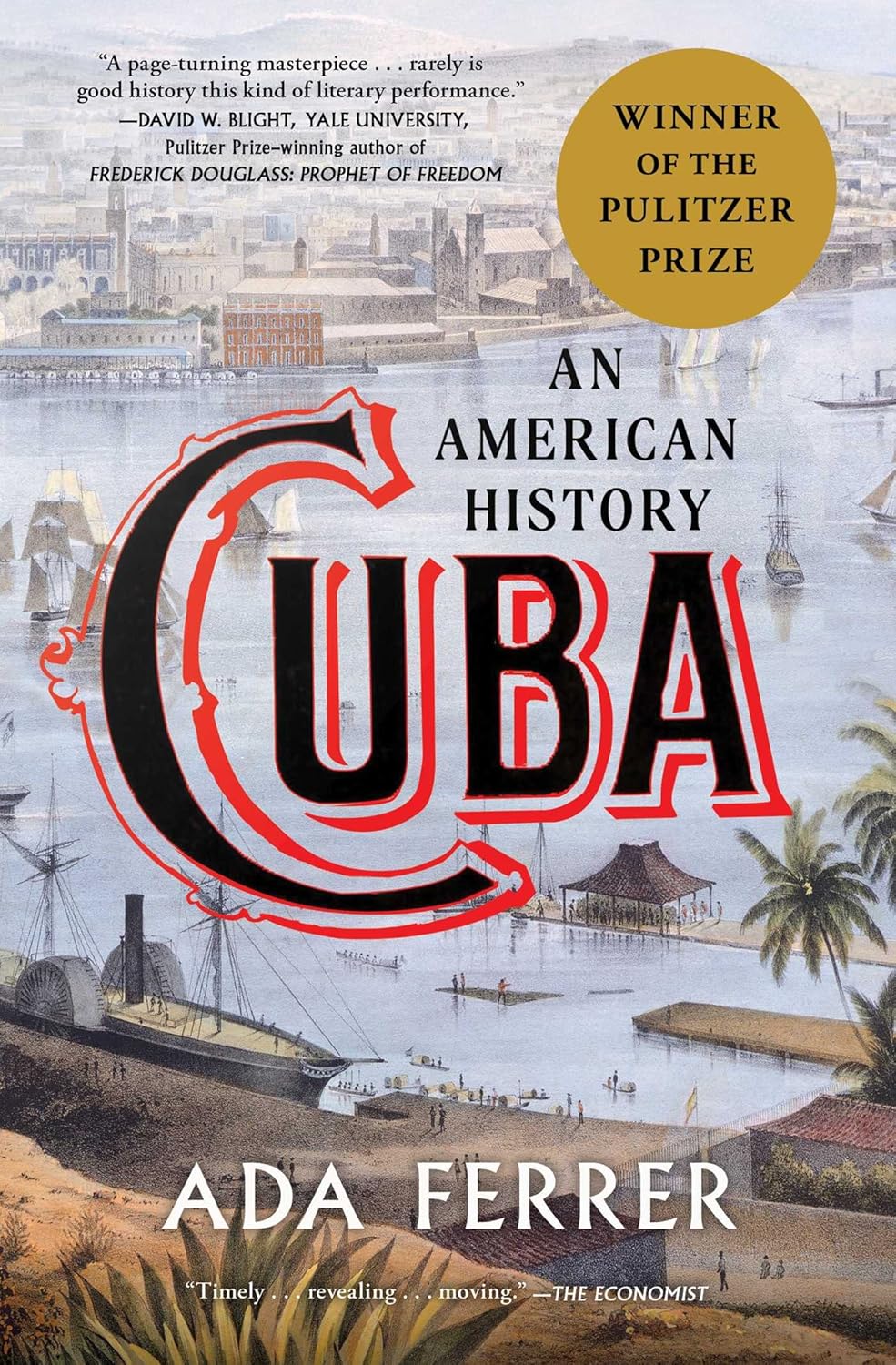
Cuba: An American History by Ada Ferrer is a sweeping, Pulitzer Prize-winning narrative (awarded the 2022 Pulitzer Prize for History). Published in 2021, the book offers a fresh, deeply researched, and often revelatory history of Cuba that places the island’s story in constant dialogue with the United States—showing how the two nations have shaped each other for more than two centuries.
Overview
Ferrer, a professor of history at New York University and a leading scholar of Cuban and Caribbean history, traces Cuba’s past from the 18th century through the present day. The book is organized chronologically but thematically rich, emphasizing recurring patterns: empire, slavery, revolution, resistance, migration, and the persistent gravitational pull of the United States.
Major sections cover:
- Colonial Cuba and the Age of Slavery (1760s–1880s)
Cuba becomes the world’s leading sugar producer after the Haitian Revolution destroys France’s most profitable colony. Ferrer details the brutal plantation system, the massive importation of enslaved Africans (more than 800,000 people), and the long, late fight for abolition (not achieved until 1886). She shows how Cuban elites tied their prosperity and identity to both Spain and the emerging U.S. market. - The Wars of Independence and U.S. Intervention (1868–1898)
The Ten Years’ War (1868–1878) and the War of Independence (1895–1898) are portrayed as genuine anti-colonial struggles led by figures like Carlos Manuel de Céspedes, Máximo Gómez, and Antonio Maceo. Ferrer argues that José Martí’s vision of a racially inclusive, independent Cuba was deliberately undermined by U.S. intervention in 1898 (the Spanish-American War), which turned Cuba into an American protectorate under the Platt Amendment. - The American Protectorate and the Batista Era (1898–1959)
The U.S. occupied Cuba militarily and economically. Ferrer examines the sugar boom, U.S. corporate dominance, corruption, inequality, and the rise of Fulgencio Batista. She shows how American influence—tourism, gambling, organized crime (Meyer Lansky, Lucky Luciano), and political meddling—created the conditions for revolution. - The Cuban Revolution and the Cold War (1959–1991)
Fidel Castro’s triumph in 1959 is presented as both a genuine social revolution and a moment that locked Cuba into confrontation with the United States. Ferrer covers the Bay of Pigs, the Missile Crisis, the export of revolution, the Angola intervention, and the economic and social achievements (literacy, healthcare) alongside repression, exodus, and dependence on the Soviet Union. - The Special Period and Beyond (1991–present)
The collapse of the Soviet Union plunges Cuba into crisis (“Special Period”). Ferrer explores survival strategies, the rise of tourism, the growth of inequality, the Obama-era thaw, the Trump rollback, and the protests of July 2021. She ends with a sobering assessment of contemporary Cuba—its resilience, its achievements, its stagnation, and its ongoing struggle for sovereignty in the shadow of the United States.
Key Arguments
- Cuba’s history cannot be understood without the United States—and vice versa. The two nations are inextricably linked by geography, economics, migration, and conflict.
- Black Cubans and Afro-Cuban culture are central to the island’s story, not marginal. Ferrer emphasizes the role of enslaved people and their descendants in the wars of independence and the revolution.
- The Cuban Revolution was both emancipatory and authoritarian; Ferrer neither romanticizes nor demonizes it.
- U.S. policy toward Cuba—embargo, invasion attempts, support for Batista, regime-change efforts—has often backfired and strengthened Castro’s hold.
- The book is deeply sourced: Ferrer draws on Cuban archives, U.S. diplomatic records, oral histories, literature, music, and visual culture to create a rich, multi-vocal narrative.
Style
The prose is vivid, accessible, and often lyrical—Ferrer is an elegant writer who knows how to make history feel alive. She balances big-picture analysis with intimate stories: enslaved rebels, independence fighters, exiles, dissidents, and ordinary people caught in the crossfire of empires.
The book won widespread acclaim for its fairness, depth, and readability. It was praised by historians, journalists, and general readers for offering a perspective that transcends both U.S.-centric and pro-Castro narratives. Critics called it “essential,” “masterful,” and “the best single-volume history of modern Cuba available in English.”
In short, Cuba: An American History is a landmark work. It shows how Cuba and the United States have been entangled for more than two centuries—in war, trade, migration, ideology, and imagination. It centers the Cuban people as active agents in their own story while never ignoring the overwhelming influence of their powerful neighbor. Essential reading for anyone who wants to understand Cuba, U.S. foreign policy, the Caribbean, or the long, complicated relationship between the two nations.