
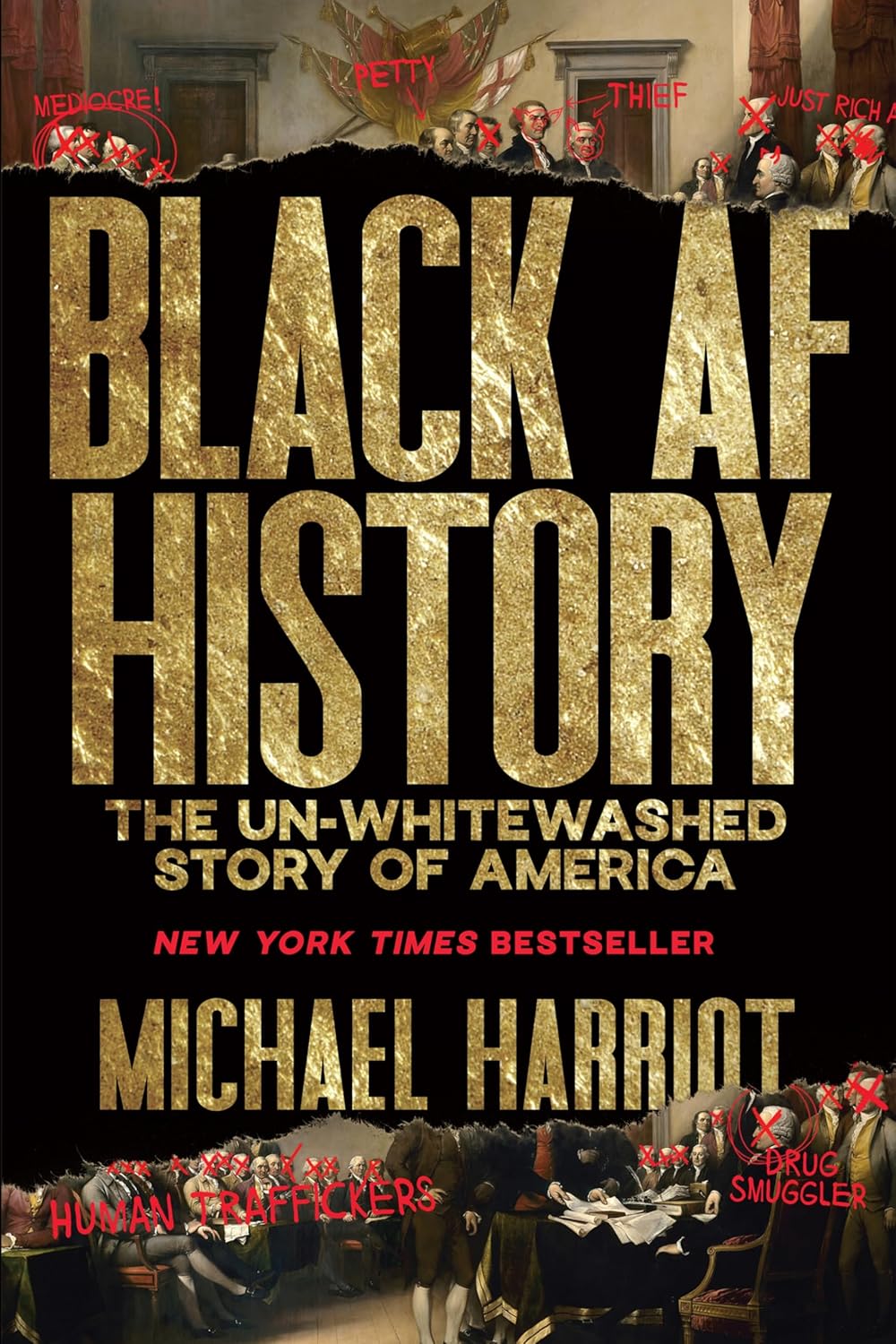
Black AF History: The Un-Whitewashed Story of America by Michael Harriot is a sharp, irreverent, and deeply researched retelling of U.S. history centered on the Black experience. Published in 2023, the book became a New York Times bestseller for its unapologetic, humorous, and unflinching approach to a subject often sanitized or marginalized in traditional textbooks.
Overview
The book is not a conventional chronological history. Instead, Harriot organizes it into thematic essays that trace how Black Americans shaped—and were shaped by—every major era and institution in the United States. Each chapter tackles a different slice of the American story through the lens of Black resilience, resistance, innovation, and survival.
Key sections include:
- The origins of race and the invention of whiteness
- The transatlantic slave trade and the economic foundation of the colonies
- The American Revolution and the hypocrisy of “liberty” built on enslaved labor
- The Civil War, Reconstruction, and the violent backlash (Jim Crow, massacres, disenfranchisement)
- The Great Migration, the Harlem Renaissance, and Black cultural power
- The civil-rights movement, Black Power, and the long shadow of COINTELPRO
- Modern issues: mass incarceration, police violence, economic inequality, and the persistent myth of post-racial America
Harriot weaves primary sources, statistics, and personal anecdotes with biting commentary and laugh-out-loud humor. He frequently breaks the fourth wall, speaking directly to the reader about how history is taught, who controls the narrative, and why certain stories are erased or softened.
Style
The writing is conversational, profane, and fiercely funny—think Ta-Nehisi Coates meets Dave Chappelle with the rigor of a historian. Harriot does not pull punches: he calls out white supremacy, systemic racism, and the complicity of “good” institutions without apology. At the same time, he celebrates Black joy, ingenuity, and defiance. The humor is never flippant; it is a survival tool and a way to make painful truths more digestible.
Key Arguments
- American history cannot be understood without centering Black people—not as victims or side characters, but as co-creators, resistors, and moral witnesses.
- Many of the nation’s most cherished myths (“land of the free,” “melting pot,” “self-made success”) were built on the exclusion, exploitation, and dehumanization of Black Americans.
- Progress has always been hard-won and partial; backlash is predictable and often more violent than the original injustice.
- Black culture, language, music, style, and resistance have profoundly shaped the United States—even when credit is rarely given.
The book received widespread praise for its accessibility, honesty, and refusal to sanitize history. It was lauded by educators, activists, and general readers who appreciated a version of American history that felt truthful rather than comforting. Some critics argued the tone was too polemical or that the humor occasionally undercut the gravity of the subject, but most reviews recognized it as a necessary corrective to traditional textbooks.
In short, Black AF History is not just a history book; it is a reclamation project. It centers Black Americans as protagonists in their own story and forces readers to confront uncomfortable truths about the nation’s past—and its present. It is ideal for anyone who wants to understand U.S. history through the lens of those who built it, bled for it, and kept fighting for its promises to be real.