
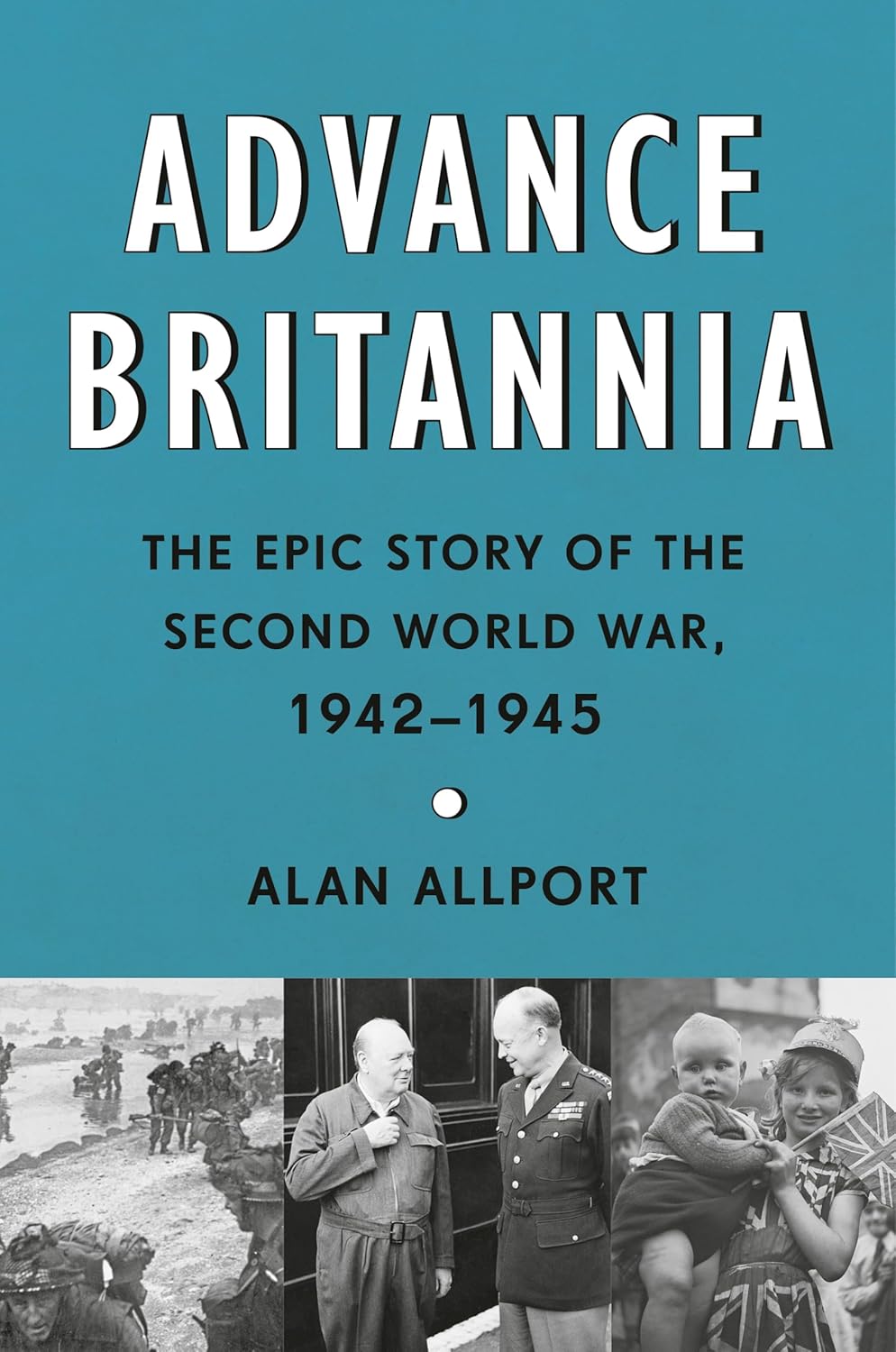
Advance Britannia: The Epic Story of the Second World War, 1942-1945
Published by Knopf (Penguin Random House) on January 6, 2026, Advance Britannia: The Epic Story of the Second World War, 1942-1945 by Alan Allport serves as the highly anticipated sequel to his acclaimed Britain at Bay (2020), which chronicled Britain’s precarious position from 1938 to 1941. At a substantial 656 pages, this hardcover completes Allport’s sweeping, multifaceted social and strategic history of Britain’s role in the Second World War, shifting focus to the pivotal years 1942–1945 when the conflict became truly global and the tide decisively turned against the Axis powers.
Allport, a professor of history at Syracuse University and a meticulous scholar of modern Britain, picks up the narrative in early 1942: Britain is no longer fighting “alone” after Pearl Harbor and the entry of the United States, yet the nation remains exhausted, its empire strained, its people rationed and bombed, and its leaders — foremost Winston Churchill — grappling with the realities of coalition warfare. The book masterfully integrates political decision-making, military campaigns, social transformations, cultural shifts, and the human costs across home front and battlefields. Key theaters receive balanced attention: North Africa and the Mediterranean (El Alamein, Torch), the strategic bombing offensive over Germany, the Battle of the Atlantic’s turning point, the Italian campaign, D-Day and Normandy, the liberation of Western Europe, and the final push into Germany. Allport also devotes significant space to the imperial dimension — the contributions and sacrifices of colonial troops from India, Africa, and the Caribbean; the growing independence movements (e.g., Quit India); and the accelerating unraveling of Britain’s global dominance.
What distinguishes Advance Britannia is its refusal to romanticize victory. Allport challenges enduring myths: Britain did not “win” the war so much as survive it through endurance, alliance-building, and German strategic blunders; the heavy lifting fell to the Soviet Union and the United States; and triumph came at the price of imperial decline, economic exhaustion, and profound social change. He overturns conventional wisdom on topics like Churchill’s strategic judgment, the efficacy and morality of area bombing, the treatment of colonial forces, and the domestic mood — showing a nation increasingly weary, skeptical of grand rhetoric, and ready for postwar reconstruction. The prose is fluid, elegant, and unsparing: gripping without sentimentality, detailed without losing narrative drive. Allport draws on a rich array of sources — diaries, letters, official records, newspapers, and oral histories — to weave personal stories (soldiers, civilians, politicians, colonial subjects) into the larger strategic arc.
Early reviews praise its nuance and freshness. The New York Times called it “an elegant and unsparing history of London’s role in World War II… [that] overturns one piece of conventional wisdom after another,” highlighting its inclusion of colonial perspectives and its sober assessment of victory’s costs. Kirkus described it as “a bracing history that sheds light both backward and forward,” noting how Allport frames Britain’s survival as a kind of qualified triumph amid imperial twilight. Book Marks aggregates “rave” ratings from initial critics, commending the seamless blend of high politics and everyday experience.
Production values match the book’s ambition: sturdy hardcover with a striking dust jacket evoking wartime maps and propaganda motifs, generous maps, photographs, and endnotes. At a list price around $40, it offers exceptional depth for the serious reader. Compared to popular single-volume WWII overviews (e.g., Antony Beevor’s The Second World War), Allport’s work is narrower in geographic scope but far richer in social texture and British-centric critique — a worthy companion to Andrew Roberts’ The Storm of War or Max Hastings’ All Hell Let Loose, yet distinct in its focus on Britain’s declining centrality.
Minor critiques include the sheer length (some may find certain sections dense) and occasional repetition of themes from the first volume, though these are minor in a work of this scale. It assumes basic familiarity with the war’s outline, making it ideal for readers who’ve already engaged with the subject rather than absolute beginners.
In summary, Advance Britannia is a superb, thought-provoking capstone to Allport’s project — an authoritative, elegantly written account that reframes Britain’s wartime experience with fresh insight, moral clarity, and unflinching realism. Essential for anyone interested in the Second World War, British history, imperial decline, or the human dimensions of total conflict. Highly recommended; it stands as one of the most accomplished WWII histories in recent years.